Introduction
When a crime happens in India, the first question that comes up is — can the police act immediately, or do they need permission from a court? The answer depends entirely on whether the offence is cognizable or non-cognizable. Understanding the difference between cognizable and non-cognizable offences in India is not just a matter of legal study — it is something every citizen should know. It tells you what rights you have, how the police are supposed to behave, and what steps you need to take when you or someone you know becomes a victim of a crime.
In this article, Advocate Pooja breaks down this important legal concept in plain, simple language so you can understand how India’s criminal justice system works.
Call Now – 9920456025
What Is a Cognizable Offence?
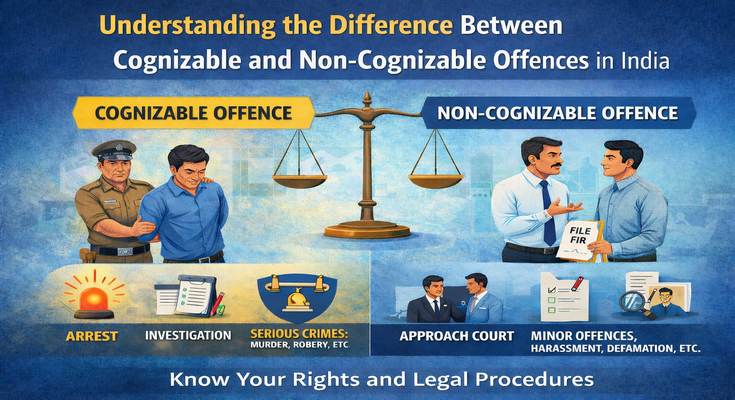
A cognizable offence is a serious crime in which the police have the power to arrest a person, conduct an investigation, and register a First Information Report (FIR) — all without needing prior permission from a magistrate.
Under Section 2(1)(g) of the Bharatiya Nagarik Suraksha Sanhita (BNSS), 2023 — which replaced the older CrPC — these are crimes that demand immediate action. They pose a direct threat to public safety, and delaying police action could cause further harm.
Common examples of cognizable offences include:
- Murder (BNS Section 101)
- Rape (BNS Section 63)
- Kidnapping (BNS Section 137)
- Robbery and dacoity
- Dowry death (BNS Section 80)
- Theft (BNS Section 303)
These are typically non-bailable offences, which means getting bail is not automatic and requires a court’s approval.
What Is a Non-Cognizable Offence?
A non-cognizable offence is a less serious crime where the police cannot arrest, investigate, or even enter private property without prior approval from a magistrate. These are usually private disputes or minor violations that do not pose an immediate threat to the public.
This category is defined under Section 2(1)(o) of the BNSS, 2023.
Common examples of non-cognizable offences include:
- Defamation (BNS Section 356)
- Public nuisance (BNS Section 270)
- Simple hurt (BNS Section 117)
- Cheating (BNS Section 318)
- Forgery (BNS Section 336)
- Assault without grievous injury
These offences are generally bailable, meaning the accused can get bail as a matter of right.
Call Now – 9920456025
Key Differences Between Cognizable and Non-Cognizable Offences
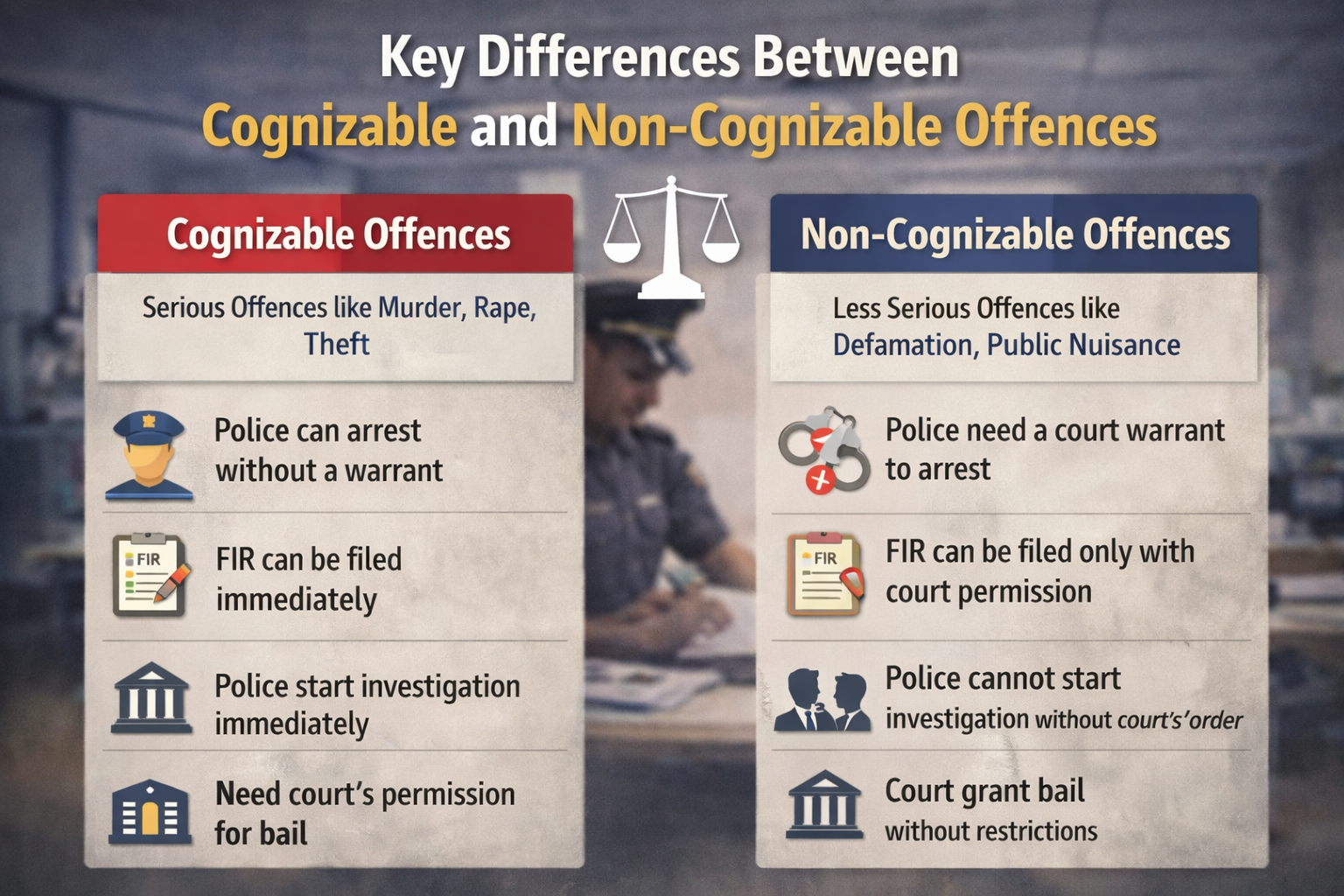
Here is a clear comparison table to help you understand how these two categories differ:
| Factor | Cognizable Offence | Non-Cognizable Offence |
|---|---|---|
| Police Arrest Power | Can arrest without a warrant | Needs a magistrate’s warrant to arrest |
| FIR Registration | Mandatory upon receiving a complaint | Registered only with magistrate’s approval |
| Investigation | Police can investigate immediately | Investigation requires court permission |
| Severity of Crime | Serious crimes (murder, rape, robbery) | Minor crimes (defamation, simple hurt) |
| Bail Status | Usually non-bailable | Usually bailable |
| Court Jurisdiction | Sessions Court | Magistrate’s Court |
| Legal Authority | Section 2(1)(g), BNSS 2023 | Section 2(1)(o), BNSS 2023 |
| Example | Murder, Kidnapping, Dowry Death | Cheating, Forgery, Public Nuisance |
Why This Classification Matters in Indian Criminal Law
The classification of offences into cognizable and non-cognizable categories is not arbitrary. It serves a very practical purpose in the Indian criminal justice system.
Here is why it matters:
- It protects public safety. For serious crimes, swift police action is necessary. The cognizable category allows police to respond immediately without waiting for court orders.
- It safeguards individual rights. For minor or private disputes, requiring judicial permission prevents police from misusing their power to harass people.
- It keeps the courts from being burdened. By allowing police to handle serious crimes directly, the system ensures courts focus their resources where oversight is most needed.
- It defines your legal options. Knowing the category of the offence helps you decide whether to go to the police directly or approach a magistrate first.
As Advocate Pooja always advises her clients: “Knowing what type of offence you are dealing with is the first step in protecting your rights.”
Call Now – 9920456025
Legal Procedure: Step-by-Step Guide
For Cognizable Offences
- Report to the nearest police station. The police are legally bound to register an FIR.
- FIR is filed under Section 173 of the BNSS. You are entitled to a free copy of the FIR.
- Police begin investigation immediately. They can arrest the accused without a warrant.
- Accused is produced before a magistrate within 24 hours of arrest.
- Case is tried in Sessions Court for serious offences.
For Non-Cognizable Offences
- File a complaint at the police station. Police will record it in the Non-Cognizable (NC) Register — not as an FIR.
- Police cannot investigate without court permission. They will refer you to a magistrate under Section 174 of BNSS.
- Approach the magistrate directly with your complaint.
- Magistrate reviews the complaint and may order the police to investigate.
- Case is tried in Magistrate’s Court.
Call Now – 9920456025
Common Mistakes People Make
Many people suffer in silence or lose their cases simply because they do not understand these basic classifications. Here are some common mistakes to avoid:
1. Approaching the police for a non-cognizable offence and expecting an FIR. The police cannot file an FIR for a non-cognizable offence without magistrate permission. Go directly to the magistrate instead.
2. Not demanding a copy of the FIR. For cognizable offences, you are entitled to a free copy of the FIR. Always ask for it. It is your legal right.
3. Assuming all bailable offences are non-cognizable. This is a very common myth. Some cognizable offences can also be bailable. The two classifications are separate.
4. Waiting too long to report a cognizable offence. Time-sensitive evidence like CCTV footage, forensic traces, or witness memories can be lost. Report immediately.
5. Not consulting a lawyer before approaching the police. A legal expert like Advocate Pooja can guide you on exactly what type of offence has occurred and what steps to take — saving you time and mistakes.
Best Practices When Dealing With Criminal Cases in India
- Always carry a valid ID when filing a complaint.
- Note down the FIR number and police officer’s name.
- Keep written records of everything, including dates and conversations.
- Do not confront the accused on your own — let the law take its course.
- Seek legal advice early. A qualified criminal lawyer can make a significant difference to the outcome of your case.
Call Now – 9920456025
Relevant Legal Provisions Under BNSS 2023
| Section | Subject |
|---|---|
| Section 2(1)(g) | Definition of Cognizable Offence |
| Section 2(1)(o) | Definition of Non-Cognizable Offence |
| Section 173 | FIR procedure for cognizable offences |
| Section 174 | Procedure for non-cognizable complaints |
| Section 175 | Right to approach higher authority if police refuse |
| First Schedule of BNSS | Classification of all offences with bail status and court jurisdiction |
Frequently Asked Questions (FAQs)
1. What is the main difference between cognizable and non-cognizable offences in India?
In a cognizable offence, police can arrest, investigate, and file an FIR without any court permission. In a non-cognizable offence, police cannot take any action without a magistrate’s prior approval. Cognizable offences are generally serious crimes, while non-cognizable ones are less severe.
2. Can police arrest someone without a warrant in India?
Yes, but only in cognizable offences. For non-cognizable offences, the police must get a warrant from a magistrate before making any arrest.
3. What should I do if police refuse to file an FIR for a cognizable offence?
You have the right to approach the Superintendent of Police with a written complaint. You can also directly file a complaint before a magistrate under Section 175 of the BNSS, 2023. The magistrate can then direct the police to register the FIR and investigate.
4. Are all non-cognizable offences bailable?
Yes, non-cognizable offences are always bailable. However, not all bailable offences are non-cognizable. Some cognizable offences can also be bailable depending on the classification given in the First Schedule of the BNSS.
5. How do I know if the offence against me is cognizable or non-cognizable?
The First Schedule of the BNSS 2023 lists every offence along with its classification. However, the easiest way is to consult a criminal lawyer like Advocate Pooja, who can quickly assess the nature of the offence and advise you on the right course of legal action.
Conclusion
The difference between cognizable and non-cognizable offences in India is more than a legal technicality — it determines how quickly you get justice. Cognizable offences allow the police to act fast without waiting for judicial orders, protecting the public from serious harm. Non-cognizable offences, on the other hand, involve judicial oversight to prevent misuse of police powers in private matters.
Whether you are a victim, an accused person, or simply a curious citizen, knowing these distinctions helps you navigate the Indian criminal justice system with confidence.
Do not leave your legal rights to chance. If you or someone you know is facing a criminal matter — whether it is a cognizable or non-cognizable offence — speak to an expert before taking any step.
Get Expert Legal Help from Advocate Pooja
Advocate Pooja is an experienced criminal lawyer committed to helping every client understand and protect their legal rights. Whether you need help filing an FIR, approaching a magistrate, or defending yourself in court — she is here to guide you every step of the way.