
A mutual divorce is granted when both spouses agree to end the marriage and have settled terms like alimony, custody, and asset division together. It’s filed under Section 13B of the Hindu Marriage Act, 1955, and typically takes 6 to 18 months, including a cooling-off period that courts can waive in certain circumstances. A mutual divorce lawyer in Navi Mumbai helps draft the settlement, file the petition correctly, and represent both motions before the local Family Court.
Introduction
Not every divorce needs to be a courtroom battle. When both spouses agree that the marriage isn’t working and are willing to settle terms together, the law offers a faster, less adversarial route — mutual consent divorce.
If you’re searching for a mutual divorce lawyer in Navi Mumbai, you’re probably past the point of trying to save the marriage and are now looking to close this chapter with as little conflict, cost, and delay as possible. This guide walks through exactly how that process works, what it actually costs, and where people commonly go wrong.
What Is Mutual Divorce?
Mutual divorce is a legal process where both spouses jointly petition the court to dissolve their marriage, having already agreed on the terms of separation — including alimony, child custody (if applicable), and division of assets.
Unlike a contested divorce, there’s no need to prove fault or blame — no allegations of cruelty, desertion, or adultery. The court’s role is largely to verify that both parties are entering the agreement freely, that the settlement is fair, and that the marriage has genuinely broken down beyond repair.
This is what makes mutual divorce faster and generally less expensive than a contested divorce — there’s no evidence to gather, no cross-examination, and far fewer hearings.
Current Indian Law on Mutual Divorce
Mutual consent divorce is governed primarily by:
- Section 13B of the Hindu Marriage Act, 1955 — applicable to Hindus, Buddhists, Sikhs, and Jains, this is the most commonly used provision for mutual divorce in Navi Mumbai and across Maharashtra.
- Section 28 of the Special Marriage Act, 1954 — for couples married under civil/interfaith provisions.
- Equivalent provisions under personal laws for other religious communities.
You can read the full text of these provisions on the Government of India’s legislative portal.
Who Can Apply for Mutual Divorce?
To file for mutual divorce under Section 13B, both spouses must satisfy the following conditions:
- They have been living separately for at least one year before filing
- They have not been able to live together as husband and wife
- They mutually agree that the marriage has broken down and should be dissolved
- Both spouses must file the petition jointly and appear together for both motions (unless the court permits otherwise)
There’s no requirement to prove wrongdoing by either party — the eligibility rests entirely on mutual agreement and the one-year separation condition.
Step-by-Step Mutual Divorce Process
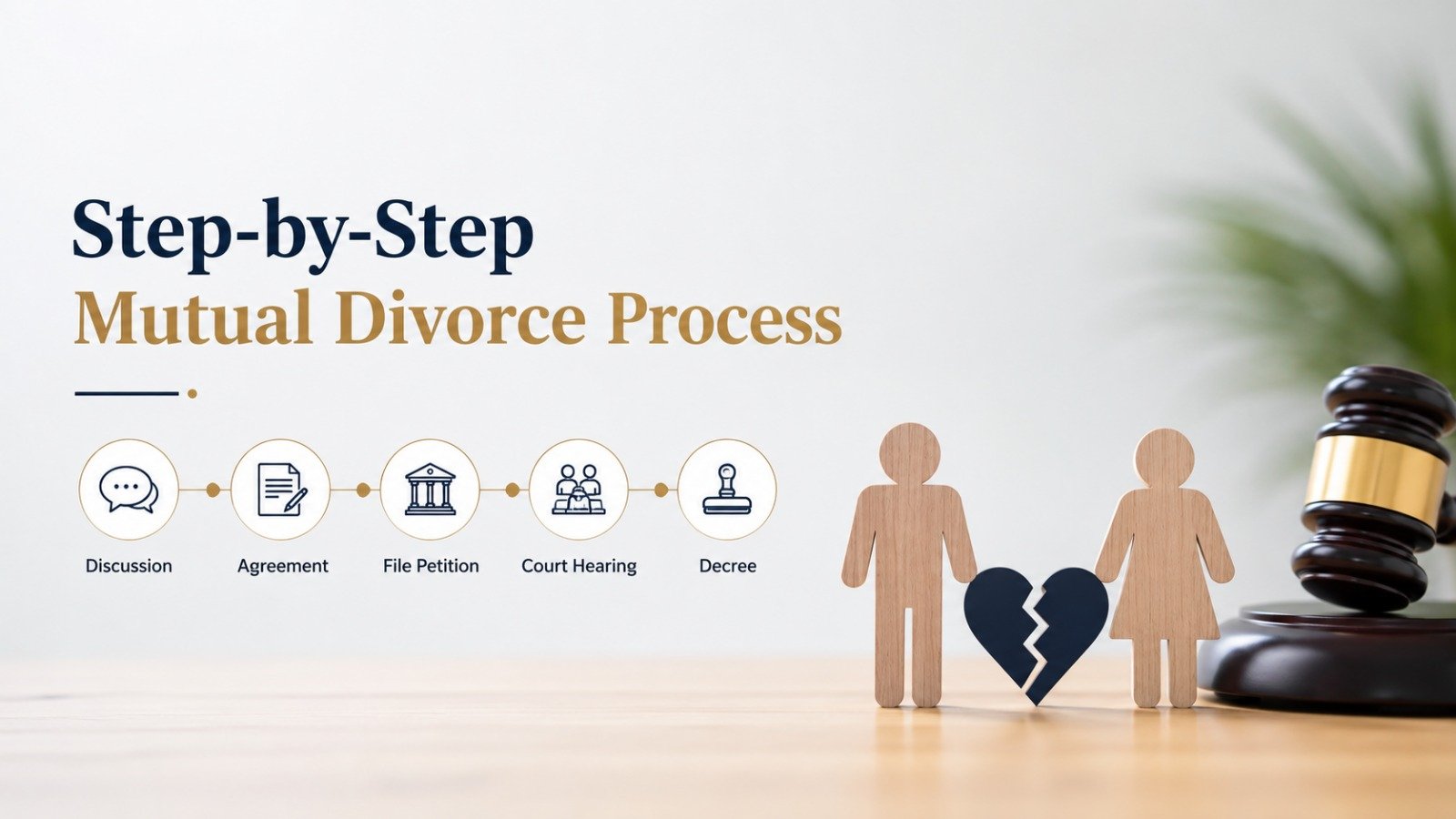
- Settlement discussion — Before filing, both spouses (often through their lawyers) negotiate and finalise terms covering alimony, custody, and asset division.
- Drafting the joint petition — A joint divorce petition is prepared, along with a signed settlement memorandum reflecting the agreed terms.
- First motion — Both spouses appear before the Family Court and record statements confirming mutual consent to divorce.
- Cooling-off period — The law requires a minimum 6-month gap between the first and second motion, intended to allow time for reconsideration.
- Second motion — After the cooling-off period (or its waiver, where granted), both spouses appear again to confirm they still wish to proceed.
- Final decree — On satisfaction, the court passes the final divorce decree, legally dissolving the marriage.
Documents Required
- Marriage certificate
- Address proof of both spouses
- Recent passport-size photographs of both parties
- Proof of separation (such as separate residence documentation, where available)
- Income proof of both spouses
- The signed settlement agreement, covering alimony, custody, and division of assets
Having these documents ready before the first motion is filed significantly reduces avoidable delays at the court stage.
Costs, Time & Practical Considerations
| Factor | Mutual Divorce | Contested Divorce |
|---|---|---|
| Typical duration | 6–18 months | 2–5 years |
| Number of hearings | Few (usually 2 motions) | Multiple |
| Cost | Generally lower | Generally higher |
| Grounds required | Mutual agreement only | Specific legal grounds |
| Cooling-off period | 6 months (waivable) | Not applicable |
Legal fees for a mutual divorce depend on how quickly both parties reach agreement, whether the settlement negotiation is straightforward, and how many hearings are ultimately needed. It’s always worth asking for a clear, written fee structure before you begin — this is something you’re entitled to ask for upfront.
Rights & Responsibilities
- Both spouses have the right to negotiate fair terms on alimony, custody, and property before the settlement is finalised — mutual consent doesn’t mean one party has to accept unfavourable terms just to speed things up.
- Once the settlement is signed and the final decree is passed, its terms are legally binding on both parties.
- Either spouse can withdraw consent at any point before the second motion is recorded — mutual divorce isn’t final until both motions are completed and the decree is passed.
- Both parents remain responsible for a child’s welfare and maintenance as agreed in the settlement, regardless of custody arrangements.
Common Mistakes to Avoid
- Rushing the settlement — Agreeing to unfavourable alimony or custody terms just to finish the process quickly often causes regret and disputes later.
- Incomplete documentation — Missing or inconsistent documents at the first motion is one of the most common reasons for delay.
- Assuming the cooling-off period is fixed — Many people don’t realise this period can be waived in the right circumstances, and end up waiting longer than necessary.
- Not formalising verbal agreements — Any settlement terms discussed outside court must be documented in writing and filed with the petition; verbal understandings hold no legal weight.
- Withdrawing consent without legal advice — If one party wants to withdraw before the second motion, doing so without understanding the legal consequences can complicate matters significantly.
Relevant Court Factors & Case Law
The mandatory six-month cooling-off period under Section 13B(2) was, for years, treated as a rigid requirement. This changed with the Supreme Court’s ruling in Amardeep Singh v. Harveen Kaur, (2017) 8 SCC 746, where the Court held that the cooling-off period is directory, not mandatory. The judgment clarified that Family Courts have discretion to waive the waiting period where:
- There is no possibility of reconciliation between the spouses
- All disputes — including alimony, custody, and property — have been genuinely and comprehensively settled
- Continuing the waiting period would only prolong hardship rather than serve its intended purpose
This precedent has made mutual divorce meaningfully faster for couples who meet these conditions, and it’s routinely relied upon in Family Courts, including in Navi Mumbai, when both spouses request an early second motion.
Navi Mumbai-Specific Guidance
For couples residing in Navi Mumbai, mutual divorce petitions are typically filed in the local Family Court with jurisdiction over the couple’s last shared residence or current address. A few practical points specific to this jurisdiction:
- Courts here generally process mutual divorce cases with fewer hearings than contested matters, provided the settlement documentation is complete at filing.
- Waiver applications for the cooling-off period, where applicable, are usually filed along with or shortly after the first motion, with supporting reasons.
- If either spouse has since relocated outside Navi Mumbai, it’s worth confirming jurisdiction with your lawyer before filing, since this can affect where the petition should be filed.
When Should You Consult a Lawyer?
Even though mutual divorce is a cooperative process, it’s still a legal one — and a lawyer’s involvement matters more than most people expect. Consult a lawyer if:
- You and your spouse are discussing separation and want to understand what a fair settlement typically looks like
- You’ve already agreed on terms but need them formalised into a legally valid settlement document
- You want to explore whether you qualify for a waiver of the cooling-off period
- Either party is unsure about their rights regarding alimony, custody, or property before finalising terms
A lawyer’s role here isn’t to create conflict where there isn’t any — it’s to make sure the agreement you sign is fair, complete, and legally sound, so it doesn’t unravel or cause disputes later.
At Advocate Pooja Agrawal & Associates, mutual and contested divorce matters are both handled as part of our family and matrimonial legal practice in Navi Mumbai. With over 18 years of litigation experience, Advocate Pooja Agrawal has guided numerous couples through the mutual divorce process, from settlement drafting to the final decree.
FAQs
Q1. How long does mutual divorce take in Navi Mumbai?
A mutual divorce typically takes 6 to 18 months, factoring in the statutory cooling-off period between the first and second motion. Where courts grant a waiver based on settled precedent, the process can conclude significantly faster, sometimes within a few weeks of the first motion.
Q2. What is the cooling-off period in mutual divorce, and can it be waived?
The cooling-off period is a mandatory-in-name six-month gap under Section 13B(2) of the Hindu Marriage Act between the first and second motion. Following the Supreme Court’s ruling in Amardeep Singh v. Harveen Kaur (2017), courts can waive this period if reconciliation is impossible and all issues are settled.
Q3. Do both spouses need to be present for mutual divorce hearings?
Yes, generally both spouses must appear together for the first and second motions. Courts may permit representation through video conferencing or, in limited circumstances, through a close relative if a spouse genuinely cannot appear in person, subject to the court’s satisfaction.
Q4. Can mutual divorce be filed if there are children involved?
Yes. Custody, visitation, and child maintenance simply need to be agreed upon and included in the settlement before filing. Courts review these terms to ensure they reflect the child’s welfare before granting the final decree.
Q5. What happens if one spouse withdraws consent after filing?
Either spouse can withdraw consent any time before the second motion is recorded, since mutual divorce isn’t final until both motions are completed. If consent is withdrawn, the case doesn’t proceed as a mutual divorce, and either party may need to pursue other legal options.
Q6. How much does a mutual divorce lawyer cost in Navi Mumbai?
Costs depend on how quickly both spouses reach an agreement and how many hearings the case requires. Mutual divorce is generally less expensive than a contested case. Always ask for a transparent, written fee structure before starting your case.
Q7. Is a mutual divorce settlement legally binding once signed?
Yes, once the settlement is signed, filed with the court, and reflected in the final decree, its terms are legally enforceable. This is why it’s important to negotiate terms carefully before signing, rather than agreeing quickly just to speed up the process.
Q8. Can mutual divorce be converted from a contested case?
Yes. If spouses in a contested divorce eventually agree on terms, the case can often be converted into a mutual consent divorce, which can significantly shorten the remaining timeline compared to continuing full litigation.
Author & Legal Review
This article is written and legally reviewed by Adv. Pooja Agrawal (B.Com, LLM — Mumbai University), founder of Advocate Pooja Agrawal & Associates, with over 18 years of litigation experience in family and matrimonial law across Navi Mumbai’s courts.
Sources
- Hindu Marriage Act, 1955 — India Code
- Special Marriage Act, 1954 — India Code
- Amardeep Singh v. Harveen Kaur, (2017) 8 SCC 746, Supreme Court of India
Related Articles
Need Help With a Mutual Divorce?
If you and your spouse are considering a mutual divorce in Navi Mumbai and want it handled correctly from the start, get in touch with Advocate Pooja Agrawal & Associates for a consultation, or learn more about the firm’s experience in family and matrimonial law.