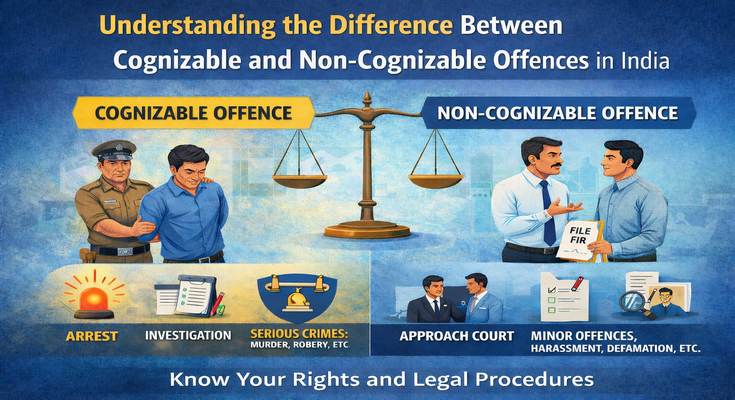

IPC Section 341 is the punishment provision for wrongful restraint under Indian law. It states that anyone who wrongfully restrains another person — meaning, illegally blocks them from moving in a direction they have a lawful right to go — shall be punished with simple imprisonment of up to one month, a fine of up to ₹500, or both. With the Bharatiya Nyaya Sanhita (BNS) 2023 coming into force on July 1, 2024, this section has been replaced by BNS Section 126(2), with the fine limit raised sharply to ₹5,000.
If you have ever been physically blocked by a neighbour, stopped at a gate by a security guard without cause, or had someone stand in your path during a dispute — you were likely a victim of an act that falls squarely under IPC Section 341. It is a small section, but it protects a massive right: your freedom to move freely.
What Is IPC Section 341?
IPC Section 341 — Punishment for Wrongful Restraint reads:
“Whoever wrongfully restrains any person shall be punished with simple imprisonment for a term which may extend to one month, or with fine which may extend to five hundred rupees, or with both.”
This section works together with Section 339 IPC, which defines wrongful restraint as:
“Whoever voluntarily obstructs any person so as to prevent that person from proceeding in any direction in which that person has a right to proceed, is said wrongfully to restrain that person.”
In plain terms: Section 339 defines the crime, and Section 341 prescribes the punishment.
Key Elements That Must Be Proved
For a conviction under Section 341, the prosecution must establish all three of these:
- Voluntariness — The act of obstruction was intentional, not accidental.
- Obstruction — The accused physically, verbally, or otherwise blocked the victim’s path.
- Lawful right of movement — The victim had a legitimate right to proceed in that direction.
If even one element is missing, the accused is entitled to an acquittal — as upheld by a Delhi court in a judgment pronounced on October 30, 2025 in FIR No. 312/2017, where the accused was acquitted because the prosecution failed to produce convincing evidence connecting them to the alleged act of restraint.
IPC Section 341 in BNS: What Changed on July 1, 2024?
This is the most critical update you need to know.
The Bharatiya Nyaya Sanhita (BNS), 2023 replaced the Indian Penal Code, 1860, with effect from July 1, 2024. Under this new law:
| Aspect | Old Law (IPC) | New Law (BNS 2023) |
|---|---|---|
| Section Number | IPC Section 341 | BNS Section 126(2) |
| Offence | Wrongful Restraint | Wrongful Restraint |
| Max Imprisonment | 1 Month | 1 Month |
| Max Fine | ₹500 | ₹5,000 |
| Community Service | Not available | Available in minor cases |
| Effective From | 1860 | July 1, 2024 |
Why does the fine increase matter? The old ₹500 fine was set in 1860 — effectively meaningless in today’s economy. The BNS revision to ₹5,000 reflects a practical recalibration that gives courts a stronger deterrent for minor but genuine violations of personal liberty.
Key Takeaway: For incidents occurring on or after July 1, 2024, police and courts will refer to BNS Section 126(2), not IPC 341. However, cases registered before that date continue to be tried under the old IPC sections.
Is IPC Section 341 Bailable or Not?
Yes — IPC Section 341 is a bailable offence.
This is one of the most frequently searched questions. Here is the full legal classification:
| Classification | Status |
|---|---|
| Bailable | Yes |
| Cognizable | Yes |
| Compoundable | Yes (with permission of court) |
| Triable By | Any Magistrate |
- Bailable means the accused has a right to bail as a matter of course — the police cannot refuse bail.
- Cognizable means a police officer can arrest without a warrant and register an FIR directly.
- Compoundable means the complainant and the accused can reach a compromise and the case can be settled with court permission.
The compoundable nature of this offence is very significant in practice. Most Section 341 disputes arise from neighbourhood quarrels, domestic disputes, or workplace altercations where both parties eventually prefer to settle. Courts regularly allow compounding in such cases, as seen in multiple High Court judgments across Punjab & Haryana, Madras, and Delhi courts.
341 and 323 IPC: What Is the Combined Punishment?
In most real-world situations, Section 341 is not charged alone. It is almost always combined with Section 323 IPC (voluntarily causing hurt), and sometimes with Section 506 IPC (criminal intimidation).
The typical pattern: the accused first restrains the victim (Section 341), then assaults them (Section 323).
Punishment Comparison: Section 341 vs Section 323
| Section | Offence | Max Imprisonment | Max Fine |
|---|---|---|---|
| IPC 341 | Wrongful Restraint | 1 Month | ₹500 |
| IPC 323 | Voluntarily Causing Hurt | 1 Year | ₹1,000 |
| BNS 126(2) | Wrongful Restraint (New) | 1 Month | ₹5,000 |
| BNS 115 | Voluntarily Causing Hurt (New) | 1 Year | ₹10,000 |
When both sections are charged together, sentences typically run concurrently (at the same time), so the effective maximum is one year — not one year plus one month.
A 2025 Supreme Court judgment (2025 INSC 46, decided January 9, 2025) involving charges under Sections 341, 323, and 324 IPC confirmed that courts weigh the totality of the accused’s conduct, the duration of the criminal process, and the possibility of a compromise before awarding punishment — providing important guidance on sentencing in combined-charge matters.
Wrongful Restraint vs Wrongful Confinement: Know the Difference
People often confuse Section 341 with Section 342 IPC (wrongful confinement). They are related but distinct offences.
| Feature | Wrongful Restraint (S.341) | Wrongful Confinement (S.342) |
|---|---|---|
| Definition | Blocking movement in one direction | Confining a person within limits |
| Nature | Partial restriction | Total restriction |
| Example | Blocking someone from leaving a room’s door | Locking someone inside a room |
| Max Punishment | 1 Month / ₹500 Fine | 1 Year / ₹1,000 Fine |
| BNS Equivalent | Section 126(2) | Section 127(3) |
Think of it this way: If you block someone from going left, that is wrongful restraint. If you ensure they cannot go anywhere, that is wrongful confinement. The severity — and therefore the punishment — is higher for confinement.
Real-World Examples Where Section 341 Applies
Understanding a law through examples is far more powerful than reading bare text. Here are genuine scenarios that attract Section 341:
Example 1 — The Landlord’s Car Blockade A landlord parks their vehicle in front of a tenant’s gate to prevent them from leaving during a rent dispute. This is textbook wrongful restraint.
Example 2 — The Security Guard Detention A mall security guard detains a customer on suspicion of shoplifting without following proper procedure and refuses to let them leave for over 20 minutes. Section 341 applies.
Example 3 — The Road Rage Block After a minor accident, one driver steps out and physically blocks the other’s car from proceeding until police arrive — without legal authority to do so. This can attract Section 341.
Example 4 — Workplace Dispute A supervisor physically stands in the doorway to prevent an employee from leaving a room during a heated argument. This is wrongful restraint even in a professional setting.
What does NOT count: A police officer stopping someone for inquiry under lawful authority, or a person stopping another to protect themselves or a third party from immediate harm — these are valid legal exceptions.
How to File a Complaint Under IPC Section 341
If you have been wrongfully restrained, here is the step-by-step process:
Step 1 — File an FIR Since Section 341 is a cognizable offence, you can walk into any police station and file an FIR. The police are legally obligated to register it.
Step 2 — Gather Evidence Evidence that strengthens your case includes: CCTV footage, witness statements, photos, medical reports (if hurt was also caused), and WhatsApp messages or calls that show intent.
Step 3 — Magistrate Complaint (Alternative) If police refuse to register the FIR, you can directly approach the Judicial Magistrate under Section 200 CrPC (now BNSS) with a written complaint.
Step 4 — Trial Section 341 cases are triable by any Magistrate. Given the minor nature of the offence, trials are typically summary in nature, which means they are resolved faster than sessions court matters.
Step 5 — Compounding If both parties agree to settle, the court can allow compounding of the offence, ending the case.
Defences Available to the Accused
An accused person charged under Section 341 has several valid defences:
- Lawful authority: If the accused had legal authority to stop the person (e.g., police, security during emergency).
- Consent: If the person voluntarily agreed to be stopped.
- Private defence: If the accused stopped the person to prevent a crime or protect themselves or others.
- Lack of voluntariness: If the obstruction was accidental, not deliberate.
- No right of movement: If the alleged victim had no lawful right to proceed in that particular direction (e.g., trespassing on private property).
Courts have consistently held — including in Punjab & Haryana High Court decisions — that the prosecution must prove intent and the specific lawful right of movement that was obstructed. Mere presence at a location does not establish wrongful restraint.
Key Takeaways: IPC Section 341 at a Glance
What it covers: Illegally blocking someone from moving in a direction they have a lawful right to go.
Punishment (IPC): Up to 1 month imprisonment, ₹500 fine, or both.
Punishment (BNS 126(2) from July 1, 2024): Up to 1 month imprisonment, ₹5,000 fine, or both.
Bailable: Yes. Arrest on bail is a right, not a privilege.
Cognizable: Yes. Police can register FIR and arrest without warrant.
Compoundable: Yes. Parties can compromise with court’s permission.
Often combined with: Section 323 (hurt) and Section 506 (intimidation).
BNS equivalent: Section 126(2) of Bharatiya Nyaya Sanhita, 2023.
FAQ: IPC Section 341 — People Also Ask
Q1. What is IPC Section 341 in simple words? IPC Section 341 punishes anyone who illegally blocks another person from moving in a direction they have a lawful right to go. The punishment is simple imprisonment up to one month, a fine up to ₹500 (now ₹5,000 under BNS), or both. It protects your constitutional right to freedom of movement under Article 19(1)(d).
Q2. Is Section 341 IPC bailable or non-bailable? Section 341 IPC is a bailable offence. This means an accused person has a legal right to bail from the police station itself. They do not need to approach a court for bail. It is also cognizable (FIR-eligible) and compoundable (can be settled by compromise with court permission).
Q3. What is IPC Section 341 in BNS 2023? IPC Section 341 has been replaced by Section 126(2) of the Bharatiya Nyaya Sanhita (BNS), 2023, effective from July 1, 2024. The imprisonment period remains the same — up to 1 month — but the maximum fine has been increased from ₹500 to ₹5,000. Community service is also a new sentencing option under BNS.
Q4. What is the punishment under 341 and 323 IPC together? When charged together, Section 341 (wrongful restraint) carries up to 1 month imprisonment, and Section 323 (voluntarily causing hurt) carries up to 1 year. Courts usually run both sentences concurrently, making the effective maximum punishment 1 year. Under BNS, the corresponding sections are 126(2) and 115 respectively.
Q5. What is the difference between Section 341 and Section 342 IPC? Section 341 covers wrongful restraint — blocking a person in one direction. Section 342 covers wrongful confinement — completely restricting a person’s movement within boundaries. Confinement is the more serious offence, attracting higher punishment of up to 1 year imprisonment and ₹1,000 fine versus 1 month and ₹500 for restraint.
Q6. Can police arrest without a warrant for Section 341 IPC? Yes. Section 341 IPC is a cognizable offence, which means the police can register an FIR and arrest the accused without obtaining a warrant from a magistrate. However, since it is also bailable, the accused can secure bail at the police station as a matter of right.
Q7. Is IPC Section 341 a compoundable offence? Yes, Section 341 is compoundable with the permission of the court. This means the victim and the accused can enter into a compromise and approach the court to have the case settled. This is common in cases arising from neighbourhood disputes, family quarrels, and minor altercations.
Q8. What evidence is needed to prove Section 341 IPC? To prove wrongful restraint, the prosecution needs to establish: (1) the accused voluntarily obstructed the victim; (2) the obstruction prevented the victim from proceeding in a specific direction; (3) the victim had a lawful right to go in that direction. CCTV footage, eyewitness testimony, and medical records (if hurt was also caused) are the strongest forms of evidence.
Q9. Can Section 341 be applied in domestic or family disputes? Yes. Section 341 applies regardless of the relationship between the parties. If a family member, spouse, or domestic partner illegally restrains you — physically blocking your movement — they can be charged under this section. It is commonly invoked in domestic disputes and matrimonial cases alongside Section 323 or other provisions.
Q10. What happens if someone is falsely charged under IPC 341? An accused person has the right to defend themselves. They can raise defences of lawful authority, private defence, consent, or absence of intent. Courts have consistently upheld acquittals where prosecution evidence was weak. A Delhi court (October 30, 2025) acquitted an accused under Sections 323, 341, and 506 IPC after finding no credible evidence connecting the accused to the alleged acts.
Q11. Is wrongful restraint a serious criminal offence in India? It depends on context. By itself, Section 341 is a minor offence (maximum 1 month imprisonment). However, it becomes serious when combined with assault (Section 323), criminal intimidation (Section 506), or if it is part of a mob offence under Sections 147/149 IPC. In such combined charge scenarios, the case can become sessions-triable and attract much higher punishment.
Q12. What is the time limit to file a complaint under Section 341 IPC? Under the Limitation Act applicable to criminal proceedings, complaints for offences punishable with fine only must be filed within 6 months. For Section 341 (which carries imprisonment as an option), the limitation period is generally 3 years from the date of the offence, though it is always advisable to file as soon as possible to preserve evidence.