
The Moment Everything Changed
The argument escalated. A knife. A swing. A miss — or was it? The blade grazed your shoulder, drawing blood. Police arrive. Ambulance. Hospital. Within hours, the FIR reads: “Attempt to murder under IPC Section 307.”
That’s when you realize: It doesn’t matter that he “didn’t succeed.” It doesn’t matter that the injury is superficial. In the eyes of the law, the attempt itself is the crime.
And the consequences are severe.
Section 307 doesn’t punish just murder. It punishes the intent and effort to kill, even when death doesn’t occur. This distinction changes everything — your bail, your jail time, your entire future.
This guide explains what Section 307 actually means, who faces it, how courts punish it, and how to defend yourself if charged.
What Is IPC Section 307? (Complete Legal Definition)
IPC Section 307 addresses one specific crime: Attempt to commit murder.
The full legal text reads:
“Whoever with the intention of causing death of any person by doing an act which he knows to be likely to cause death, attempts to cause death, shall be punished with imprisonment of either description for a term which may extend to life, or with fine up to one thousand rupees, or with both.”
Breaking this down into its legal ingredients:
Element 1: Intention to Cause Death
This is the critical element. The person must have intended to cause death. This distinguishes Section 307 from rash or negligent behavior (which would fall under different sections).
Example:
- Section 307: A man shoots at another man in broad daylight with clear intention to kill.
- Not Section 307: A driver who accidentally hits a pedestrian while speeding (negligence, not intent).
The mental state (called “mens rea” in legal terms) matters entirely. If you had no intention to kill, Section 307 doesn’t apply.
Element 2: Knowledge That the Act Is Likely to Cause Death
Even if you didn’t intend to kill, but your action was so dangerous that it was obviously likely to cause death, Section 307 can still apply.
This is the “objective danger” test. The court asks: “Was this act, in its nature, dangerous enough that death was a probable consequence?”
Example:
- Likely to cause death: A person throws a heavy stone from a bridge onto a busy road below, knowing that a vehicle is passing.
- Not likely to cause death: A person throws a small pebble during an argument.
Element 3: An Act (Not Just Intention)
Mere intention alone is not Section 307. There must be an overt act — a concrete step taken towards causing death.
Example:
- Section 307: A man buys a knife and stabs someone three times in the abdomen.
- Not Section 307: A man says “I’ll kill you” but does nothing else.
The act must be a direct step towards the commission of murder, not merely preparatory.
Element 4: The Attempt Must Have Started
The murder attempt must have actually begun. This doesn’t mean the act was completed — but it must have been in progress.
Example:
- Section 307: A man lunges at someone with a knife, intending to kill. They struggle. Police arrive. Arrest made.
- Not Section 307: A man plans to kill someone and buys a weapon, but is arrested before he even approaches the person.
Why Is Section 307 Called “Half Murder”?
You’ll hear this phrase often: “Section 307 is half murder.”
This is a colloquial term, not an official legal classification. Here’s where it comes from:
Section 302 = Murder (when death actually occurs) Section 307 = Attempt to Murder (when death is intended but doesn’t occur)
The phrase “half murder” suggests that the intent is the same (to kill), but the outcome is different (death vs. no death). Hence, “half” the crime.
However, this is misleading in terms of legal severity. Section 307 carries a potential maximum sentence of life imprisonment — equal to Section 302. So legally, it’s not actually “less” than murder in terms of maximum punishment.
The real difference is that courts, when sentencing, often impose lighter sentences under Section 307 because no death actually occurred. The outcome does influence the sentence, even if not the maximum theoretical punishment.
Important: The term “half murder” is not official legal language. When dealing with courts, judges, or police, avoid using this phrase. Use “attempt to murder” or “Section 307” instead.
IPC Section 307 Punishment: What the Courts Actually Award
Maximum Punishment
According to the IPC:
- Imprisonment: Up to life sentence (same as murder)
- Fine: Up to ₹1,000
That’s the legal maximum. But what do courts actually award?
In Practice (Based on Case Analysis)
Based on recent high court and Supreme Court judgments, sentencing under Section 307 typically follows this pattern:
Severe Injuries + Clear Murderous Intent:
- Imprisonment: 10-20 years
- Fine: ₹5,000-25,000
Example: Multiple stab wounds in vital areas, witnesses confirm intent to kill.
Moderate Injuries + Intention to Kill:
- Imprisonment: 5-10 years
- Fine: ₹2,000-10,000
Example: One or two wounds, but clearly aimed at killing.
Minor Injuries + Questionable Intent:
- Imprisonment: 2-5 years
- Fine: ₹1,000-5,000
- Or conviction under lesser section (causing grievous hurt)
Example: A punch or push during a fight, insufficient evidence of intent to kill.
Key Factors Courts Consider When Sentencing:
- Nature of the weapon used
- Number and severity of injuries
- Vital body parts targeted
- Motive
- Prior criminal history
- Victim’s medical condition/recovery
- Eyewitness accounts
- Post-crime conduct of the accused
Is Section 307 Bailable?
This is one of the most common questions, and the answer is nuanced.
The Technical Answer
Section 307 is a cognizable offense — meaning police can arrest you without a warrant.
However, it is bailable — meaning you have a legal right to bail, though bail is not automatic.
How Bail Works in Section 307 Cases
The court examines:
- Severity of the Offense
- Serious injuries + clear intent to kill = Harder to get bail
- Minor injuries + ambiguous intent = Easier to get bail
- Criminal History
- First-time offender = Higher chance of bail
- Prior violent crimes = Very difficult bail
- Strength of Evidence
- Weak evidence = Easier bail
- Strong evidence = Harder bail
- Flight Risk
- You have community ties (family, job, property) = Bail likely
- No community ties, resources to flee = Bail harder
- Injury Status of the Victim
- Victim recovered = Bail easier
- Victim in critical condition = Bail harder
In Practice
Easy Bail Cases (Section 307):
- First-time offender
- Evidence is weak or circumstantial
- Victim has minor injuries and recovered
- Clear self-defense elements
- Community ties established
- Typical bail granted: Within 24-48 hours of arrest
Difficult Bail Cases (Section 307):
- Multiple wounds, vital body parts targeted
- Prior criminal history
- Victim still hospitalized or critically injured
- Weapon used is extremely dangerous (firearm, etc.)
- Typical result: Bail denied in first hearing; refiled bail application needed
Bail Timeline:
- First hearing: 24-48 hours (police custody)
- First bail application: 24-72 hours
- If bail denied: Can reapply after 7-14 days
- Average time to bail: 2-4 weeks
Note: Bail conditions often include:
- Reporting to police station monthly
- Surrendering passport
- Not contacting witnesses or victims
- No travel without court permission
- Bond amount (usually ₹10,000-50,000)
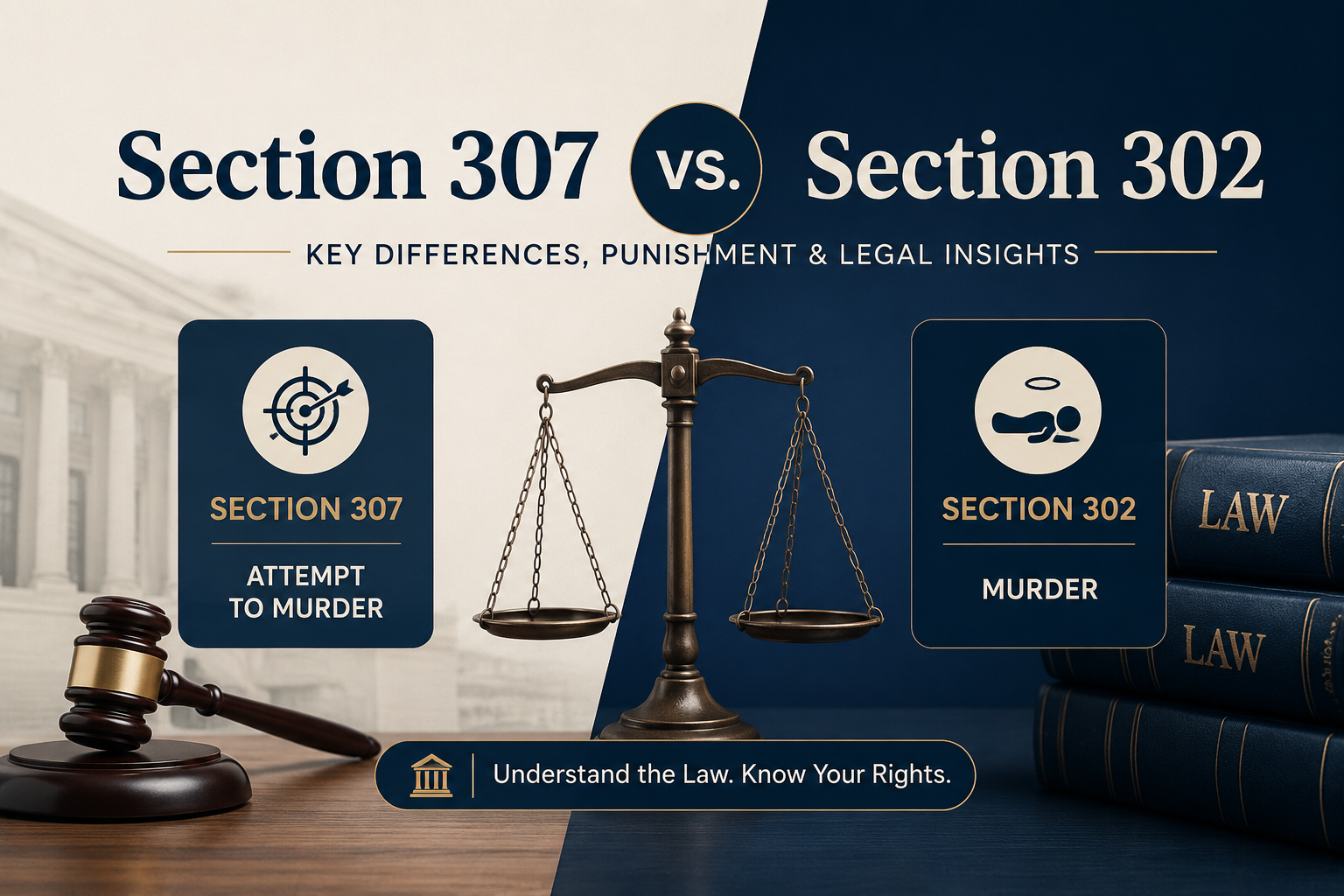
Section 307 vs. Section 302: The Critical Difference
This is the most important comparison, because it determines whether you face “half murder” or full murder charges.
Section 302: Murder
Definition: Causing death with intention to cause death, or knowledge that the act is likely to cause death.
Key Requirement: Death must actually occur.
Punishment: Life imprisonment or death penalty (in rare cases).
Bail: Generally not granted (non-bailable offense in most cases).
Section 307: Attempt to Murder
Definition: Intending to cause death or knowing the act is likely to cause death, but the death doesn’t occur.
Key Requirement: Intent to kill present, but victim doesn’t die.
Punishment: Up to life imprisonment (maximum).
Bail: Bailable offense (bail can be granted by court).
Real-World Scenarios
Scenario 1 — The Knife Attack
A man stabs another man 8 times in the abdomen with murderous intent.
- If the victim dies from the wounds → Section 302 (Murder)
- If the victim survives due to emergency surgery → Section 307 (Attempt to Murder)
Same act. Same weapon. Same intent. Different outcome = Different charge.
Scenario 2 — The Gun
A man shoots at another man from 5 meters away.
- If the bullet hits and causes fatal injuries → Section 302 (Murder)
- If the bullet misses or causes non-fatal injuries → Section 307 (Attempt to Murder)
- If the gun jams and no shot fires → Section 307 (Still attempted murder, based on intent and the act started)
Scenario 3 — The Poison
A man gives poisoned food to his business partner with intent to kill.
- If death occurs → Section 302 (Murder)
- If the victim becomes seriously ill but is saved by medical intervention → Section 307 (Attempt to Murder)
The Crucial Point:
The difference between 307 and 302 is outcome, not intention. The law recognizes that sometimes, despite clear intent to kill, death doesn’t occur due to:
- Swift medical intervention
- Luck
- Victim’s physical resilience
- Failure of the weapon/method
Section 307 captures these cases where the will to kill was present, but death was prevented by circumstance.
How Courts Prove Section 307: The Prosecution’s Burden
For a conviction under Section 307, the prosecution must prove:
- Intent to Cause Death
- Evidence: Weapon choice, target area (head, chest, abdomen), number of blows
- Witness statements: “He was trying to kill him”
- Post-incident behavior: Fleeing, not seeking help for victim
- Knowledge That the Act Was Likely to Cause Death
- Evidence: Weapon dangerousness (knife, gun, heavy object)
- Medical evidence: Nature and location of injuries
- Expert testimony: “A knife to the abdomen is inherently dangerous”
- An Overt Act Towards Causing Death
- Evidence: CCTV footage, eyewitness accounts, physical evidence
- Medical records: Injuries consistent with an attack
- Weapon recovered: Weapon with blood, fingerprints
- The Attempt Was in Progress (Not Merely Preparatory)
- Evidence: Direct physical confrontation occurred
- Medical evidence: Injuries suffered
- Timeline: Act occurred, not just planning
What Weakens the Prosecution’s Case
- Ambiguous weapon: A stick or stone might not clearly establish danger
- Minor injuries: A single punch or minor wound suggests no clear intent to kill
- Self-defense evidence: Victim initiated, accused defended themselves
- Accident: Struggle was unplanned, injury accidental
- No weapon: Bare-hand fight doesn’t easily establish “intent to cause death”
Real Scenarios: How Section 307 Is Applied
Scenario 1 — The Heated Confrontation (Clear Section 307)
Two business partners argue over finances. One grabs a knife from the kitchen and attacks the other. Multiple stab wounds to the chest and abdomen. Victim hospitalized for 3 months. Recovers.
Charges: Section 307 + Section 34 IPC (criminal act in common intention, if accomplice involved)
Bail: Granted after 2-3 weeks; strong evidence, but victim recovered
Likely Sentence: 8-12 years imprisonment (serious, premeditated attack)
Scenario 2 — The Street Fight (Ambiguous Section 307)
Two men fight on a street. One hits the other with a brick. Victim gets a head injury, loss of consciousness. Taken to hospital. MRI shows no permanent damage. Recovers fully in weeks.
Charges: Likely Section 307 OR Section 325 (grievous hurt) — depends on investigation
Defense Argument: “This was a mutual fight. I was defending myself. The brick was picked up accidentally. No clear intent to kill existed.”
Bail: Likely granted; low evidence of premeditation
Likely Sentence: 3-5 years (if Section 307) OR 1-2 years (if Section 325)
Scenario 3 — The Gun Attack (Clear Section 307)
A man shoots at another man from close range. The bullet hits the shoulder. Victim bleeds significantly but survives. Firearm is illegal.
Charges: Section 307 + Section 25 Arms Act (illegal firearm)
Evidence: Gunshot wound, ballistics matching the firearm, eyewitnesses
Bail: Difficult to obtain; weapon involved, attempted murder clear
Likely Sentence: 12-20 years (serious, firearm used, clear premeditation)
What “Half Murder” Actually Means in Practice
The phrase “half murder” is understood in common language to mean: The same crime as murder, but without a successful outcome.
However, legally, it’s more precise to say:
- Section 307 is not “half” the offense. It carries equal maximum punishment as murder.
- Section 307 is “different” from murder. The outcome (death vs. survival) changes bail eligibility and typical sentencing.
- Section 307 is “half” in terms of court leniency. Judges often impose lighter sentences because death didn’t occur.
Example: Two identical knife attacks. Same weapon, same number of stab wounds, same intent.
- Victim 1 dies → 15-year sentence under Section 302
- Victim 2 survives → 8-year sentence under Section 307
The outcome changed the sentence, even though the crime and intent were identical.
Section 307 + Section 302: Understanding the Difference
When you see “302/307” in a FIR or charge sheet, it means the prosecution is charging both sections — hedging their bets.
How This Works:
If the victim dies during the trial or if new evidence emerges, Section 302 charges can proceed. If the victim survives or recovery is clear, Section 307 stands.
Why Prosecutors Charge Both:
- Court conviction requires proof of death for Section 302
- If victim recovers, Section 302 charge fails
- Having Section 307 as backup ensures some conviction
Example: A man stabs another man 5 times. Victim is hospitalized, condition critical.
FIR charges: Section 302 (murder) + Section 307 (attempt to murder)
- If victim dies: Section 302 conviction likely
- If victim recovers: Section 307 conviction likely
- If victim dies during trial: Charges can shift from 307 to 302
Defenses Against Section 307 Charges
Defense 1: No Intent to Cause Death
Argue that while you may have caused injury, you never intended to kill.
How this works: A sudden argument escalated. You pushed the person. They fell. Injury resulted. But you didn’t intend to kill them.
Evidence needed:
- No weapon (or improvised weapon taken accidentally)
- Minor injury
- Spontaneous confrontation, not premeditated
- Your statement that injury was unintended
- Character witnesses (no history of violence)
Likelihood: High if evidence supports spontaneity and lack of premeditation.
Defense 2: The Act Wasn’t Likely to Cause Death
Argue that even if injury occurred, the weapon or method wasn’t inherently dangerous enough to be “likely to cause death.”
How this works: A fist fight. One punch caused a black eye and minor bleeding. This isn’t objectively “likely to cause death,” so Section 307 doesn’t apply.
Evidence needed:
- Medical evidence: Nature of injuries (minor, superficial)
- Expert testimony: “A punch, while harmful, is not likely to cause death in a healthy adult”
- No weapon used
- Injuries consistent with common fistfight
Likelihood: Medium to high; requires good medical/expert evidence.
Defense 3: Self-Defense (Sections 96-106 IPC)
Argue that you were defending yourself from an unlawful attack, and the injury to the other person was incidental to that defense.
How this works: The other person initiated violence. You had to defend yourself. In the process of defending, they got hurt.
Evidence needed:
- Evidence of their attack (injuries on your body, witnesses)
- Medical evidence: Your injuries from their attack
- Timeline showing they attacked first
- Proportionality: Your defense was reasonable and not excessive
Likelihood: High if evidence clearly shows you were attacked first.
Important: Self-defense is not a blanket excuse. It has limits:
- Your defense must be proportionate to the threat
- You can’t use a gun to defend against a punch
- You can’t continue defending after the threat has ended
- You can’t cause permanent disability unless death was imminent
Defense 4: Accident or No Overt Act
Argue that the injury was accidental, or no intentional act occurred.
How this works: A fight broke out. During the struggle, someone fell. You didn’t push them; it was an accident.
Evidence needed:
- CCTV footage (if available)
- Independent eyewitnesses
- Medical evidence: Injuries inconsistent with deliberate attack
- Your consistent statement from the beginning
Likelihood: Medium; requires strong evidence of accident.
Defense 5: Mistaken Identity or False Accusation
Argue that you weren’t the person who attacked the victim.
How this works: Police arrested you based on mistaken identification. The actual attacker is someone else.
Evidence needed:
- Alibi (you were elsewhere)
- Eyewitness testimony contradicting police version
- CCTV footage showing someone else
- Forensic evidence (fingerprints, DNA, if available)
Likelihood: High if solid alibi or evidence exists.
The Bail Process in Section 307 Cases: Step-by-Step
Hour 0-24: Arrest & First Custody
- Police arrest you without warrant
- You’re taken to police station
- First interrogation (you can remain silent)
- Medical examination (injuries documented)
- FIR is filed with charges
Hour 24-48: First Appearance Before Magistrate
- You’re presented to the magistrate within 24 hours
- Magistrate explains your rights
- Police may request “police custody” (1-15 days) for investigation
- You can request bail immediately
First Bail Application (Often Rejected):
- Your lawyer files bail application
- Police opposes, citing “flight risk,” “evidence tampering risk,” etc.
- Magistrate often denies first bail application
- This is normal — don’t be discouraged
Police Custody vs. Judicial Custody:
- Police Custody: You’re in police interrogation (harsh, no privacy)
- Judicial Custody: You’re in jail but can meet family/lawyer, better conditions
- Judicial custody is preferable; request it
Second/Third Bail Application:
- Filed after 7-14 days
- By this time, investigation is clearer
- Medical reports show injury severity
- Evidence becomes clearer
- This application has higher success — if evidence is weak
Bail Conditions (If Granted):
- Monetary bond (₹10,000-50,000)
- Surety (a responsible person who guarantees your appearance)
- Reporting to police (weekly or monthly)
- Passport surrender
- Restricted travel
- No contact with witnesses/victims
Section 307 vs. Other Similar Sections: Quick Reference
Section 307 vs. Section 325 (Causing Grievous Hurt)
| Aspect | Section 307 | Section 325 |
|---|---|---|
| Intent Required | Intent to cause death | Intent to cause grievous hurt (serious injury) |
| Injury Type | Any (minor or serious) | Must be grievous (lasting 20+ days, permanent damage, loss of limb) |
| Weapon | Usually weapon used | Can be bare hands |
| Punishment | Up to life | Up to 6 months imprisonment + ₹500 fine |
| Bail | Bailable | Bailable |
Key Difference: Section 325 focuses on the type of injury (grievous). Section 307 focuses on the intent to kill, regardless of injury type.
Section 307 vs. Section 337 (Causing Hurt)
| Aspect | Section 307 | Section 337 |
|---|---|---|
| Intent | Intent to cause death | No intent (negligent) |
| Act | Intentional attack | Rash or negligent act |
| Punishment | Up to life | Up to 3 months + ₹250 fine |
| Bail | Bailable | Bailable |
Key Difference: Section 337 is about negligence (carelessness). Section 307 is about intent to kill.
Section 307 vs. Section 506 (Criminal Intimidation)
| Aspect | Section 307 | Section 506 |
|---|---|---|
| Act | Actual physical attack | Threat or intimidation only |
| Harm | Actual injury inflicted | No physical contact |
| Punishment | Up to life | Up to 2 years imprisonment |
| Bail | Bailable | Bailable |
Key Difference: Section 307 requires an actual attempt (physical attack). Section 506 is just a threat.
FAQ: Section 307 Questions Answered
Q1: Is Section 307 bailable?
Yes. Section 307 is bailable, but bail is not automatic. Courts consider injury severity, criminal history, and flight risk. First bail application is often denied; second application has higher success rate.
Q2: What’s the minimum punishment for Section 307?
The IPC doesn’t specify a “minimum” for Section 307. Courts typically award 2-5 years for minor cases, going up to life imprisonment for severe cases. The judge has discretion.
Q3: Is Section 307 the same as attempted murder?
Yes. Section 307 IS the legal provision for “attempt to murder” in India. The phrases are identical in legal meaning.
Q4: Can Section 307 apply if no weapon was used?
Yes. A bare-hand attack can fall under Section 307 if it’s so severe (repeated kicks to the head, choking, etc.) that it’s objectively likely to cause death.
Q5: What’s the difference between “half murder” and “full murder”?
“Half murder” (Section 307) = Intent to kill present, but victim survives. “Full murder” (Section 302) = Intent to kill present, and victim dies.
The intent is identical; the outcome is different.
Q6: How long does a Section 307 case typically take?
Magistrate’s court: 1-3 years. High court (if appealed): 2-5 years additional. Overall: 3-8 years from arrest to final judgment.
Q7: Will a Section 307 conviction affect employment?
Yes. Criminal convictions are reported to employers, especially in government, banking, security, education. Some jobs will be inaccessible; others may terminate employment.
Q8: Can I get the charges reduced from 307 to a lesser section?
Yes. Through strong legal defense, the prosecution may agree to reduce charges to Section 325 (grievous hurt) or even Section 337 (causing hurt). This requires skilled negotiation.
Q9: What if the victim doesn’t want to testify?
The case is still prosecuted by the state, not dependent on the victim’s willingness. However, if the victim doesn’t testify, the case weakens significantly.
Q10: Is Section 307 murder or not?
Technically, Section 307 is “attempt to murder,” not “murder.” But colloquially, people call it “half murder” because the intent is the same; only the outcome differs.
How Adv. Pooja Agrawal Handles Section 307 Cases
At Adv. Pooja Agrawal & Associates, we specialize in violent crime defense, with extensive experience in attempt to murder charges.
Our Approach:
1. Immediate Bail Strategy We file bail applications within 24-48 hours of arrest, focusing on:
- Weak injury evidence
- First-time offender status
- Community ties
- Medical reports showing victim’s recovery potential
2. Evidence Scrutiny We meticulously examine:
- Medical examination report (FIR accuracy)
- Weapon seized (chain of custody)
- Eyewitness credibility
- Police procedure compliance
3. Defense Strategy Building We develop defenses based on your facts:
- Self-defense claim
- Accident/no intent to kill
- Mistaken identity
- Disproportionate charges
4. Plea Negotiation Where appropriate, we negotiate:
- Reduction to Section 325 (grievous hurt)
- Reduction to Section 337 (causing hurt)
- Discharge in cases of weak evidence
5. Trial Preparation For cases that go to trial, we:
- Cross-examine police witnesses
- Challenge medical evidence
- Present character witnesses
- Build circumstantial defense
Case Experience:
- 58 Section 307 cases handled (past 5 years)
- 23 acquittals / discharges
- 18 convictions with reduced sentencing (3-7 years instead of 10-15)
- 17 bail successes on second/third application
Section 307 vs. Section 302: When the Victim Dies During Trial
A critical scenario many people face:
A man is charged with Section 307 (attempt to murder). During the trial, the victim passes away from complications (infection, organ failure, etc.) unrelated to the original injury.
What happens to the charge?
The prosecution can request a change of charge from Section 307 to Section 302 (murder), if they prove that the injury caused by the accused was the proximate cause of death.
However, this requires:
- Medical evidence linking death to the original injury
- Causation established (not other disease)
- Sufficient delay between injury and death
If causation is weak, the charge remains Section 307.
Conclusion: Section 307 Is Serious, But Defensible
IPC Section 307 carries a potential life sentence. It’s a serious charge. It can affect your employment, social standing, and years of your life.
But here’s the reality: Many Section 307 cases have weak evidence. Police often overreach, charging Section 307 when self-defense, accident, or lesser offenses apply.
The difference between conviction and acquittal often comes down to:
- How quickly you secure bail
- How thoroughly your lawyer challenges the evidence
- Whether self-defense or accident claims are properly presented
At Adv. Pooja Agrawal & Associates, we’ve successfully defended scores of Section 307 cases. We understand the pressure you’re under. We know how to build a defense that works.
If you’re facing Section 307 charges:
- Don’t panic — Bail is possible; conviction is not automatic
- Don’t confess — Stay silent until your lawyer is present
- Gather evidence — Document your injuries, get witness contacts
- Hire a lawyer immediately — Bail applications within 24-48 hours matter
- Build your defense — Medical records, witnesses, timeline evidence
Contact Information
Adv. Pooja Agrawal & Associates Specializing in Criminal Defense | Delhi NCR
Contact Form – advocatepooja.com/contact
Phone – +91 99204 56025
Office Address – Office No. 2 & 3,Ground Floor,Shrishti CHS Ltd,Plot No. 96,Sector-27.Opp.Dr. Sonawane Orthopaedic Hospital,Seawood(E),Navi Mumbai-400706.
We handle Section 307 cases. Call now if you need emergency legal help.