The Day Everything Changed
July 1, 2023. That’s the date India’s 175-year-old criminal law system was officially replaced.
The Indian Penal Code — drafted by Thomas Macaulay in 1860 — was gone. In its place stood a new framework: the Bharatiya Nyaya Sanhita (BNS), or the Indian Justice Code.
For most people, this felt abstract. Legal term. Government announcement. Few realized the magnitude.
But for anyone navigating India’s criminal justice system — whether you’re a victim seeking justice, an accused defending yourself, or a professional building a legal practice — this wasn’t just a law change.
It was a complete overhaul.
The procedures changed. The rights changed. Even the way courts interpret criminal charges shifted fundamentally. Cases that would take 8 years to resolve under IPC now move faster under BNS. Bail conditions are different. Evidence rules are rewritten. Digital crimes — barely addressed in 1860s IPC — now have entire sections dedicated to them.
And yet, most people don’t know what’s actually different. They assume it’s the same law with a new name.
It isn’t.
What Exactly Is the IPC?
The Indian Penal Code came into force on January 26, 1862. It was British India’s gift to the Indian legal system — written by the legendary Macaulay commission, it served as the foundation for criminal justice for 161 years.
The IPC was, at its time, progressive. It codified criminal liability. It defined offenses clearly. It attempted fairness through section-based classification of crimes.
But here’s the thing: it was written in the 1860s. By intent, for an India under colonial rule. Its language was dense. Its procedures were adversarial (borrowed from English common law). Its definitions were rigid.
Digital crimes didn’t exist in 1860. Cyberstalking wasn’t a concept. Online fraud was impossible. Sexual harassment in the workplace was not legally recognized. The IPC’s provisions on these topics were either absent or wildly inadequate.
What Made the IPC:
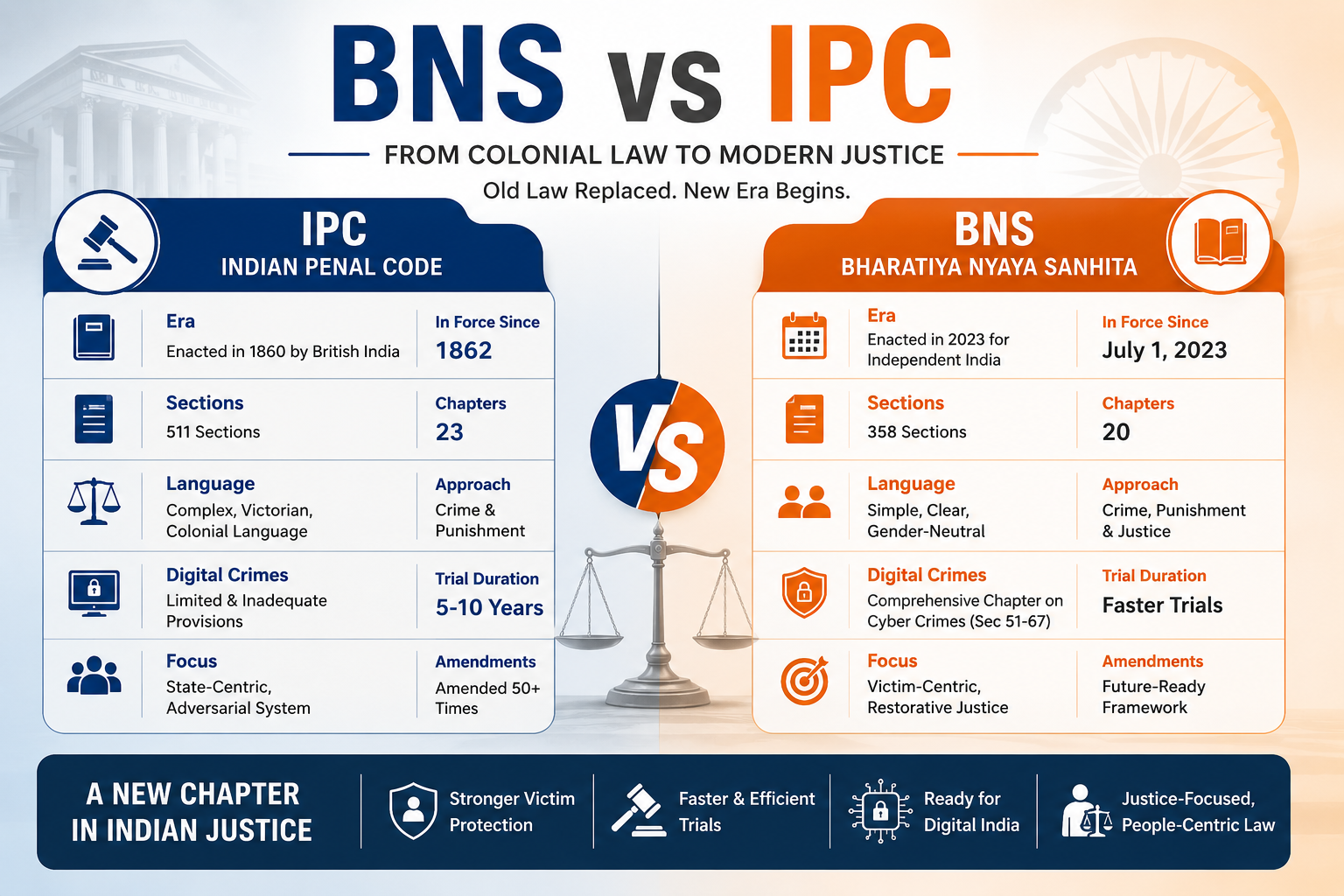
- 511 sections (divided into 23 chapters)
- Comprehensive definitions of offenses (theft, murder, assault, defamation, etc.)
- Classification into “cognizable” crimes (police can arrest without warrant) and “non-cognizable” crimes
- A graded system of punishments
- Procedural complexity that often favored lawyers over justice seekers
The Problem: By 2023, the IPC was outdated. Courts were clogged. Trials took 5-10 years. Technology-based crimes fell through legal cracks. The law had been amended 50+ times, creating a patchwork of contradictions.
What Is the Bharatiya Nyaya Sanhita (BNS)? (The New Law)
The Bharatiya Nyaya Sanhita (BNS) is India’s new criminal code. It came into force on July 1, 2023, completely replacing the IPC.
The name itself is symbolic. “Bharatiya” means Indian. “Nyaya” means justice. “Sanhita” means code or compilation. Together: India’s Justice Code.
Drafted by a committee led by former Justice V. Chandrasekhara Srinivasan, the BNS was designed for modern India. It addresses digital crimes. It simplifies procedures. It focuses on victim protection. It reflects India’s constitutional values (written in 1950, not 1860).
What the BNS Contains:
- 358 sections (fewer but more specific than IPC)
- Clearer language (less archaic, more direct)
- Dedicated provisions for digital crimes, cyberstalking, online fraud
- Faster trial procedures
- Enhanced victim protection measures
- Provisions for restorative justice (not just punishment)
- Aligned with India’s Constitution and international legal standards
The Philosophy: IPC was about defining crime and punishment. BNS is about defining crime, punishment, AND justice. It’s more victim-centric. More pragmatic. More Indian in spirit.
BNS vs IPC: Key Differences at a Glance
Here’s what changed. Fundamentally.
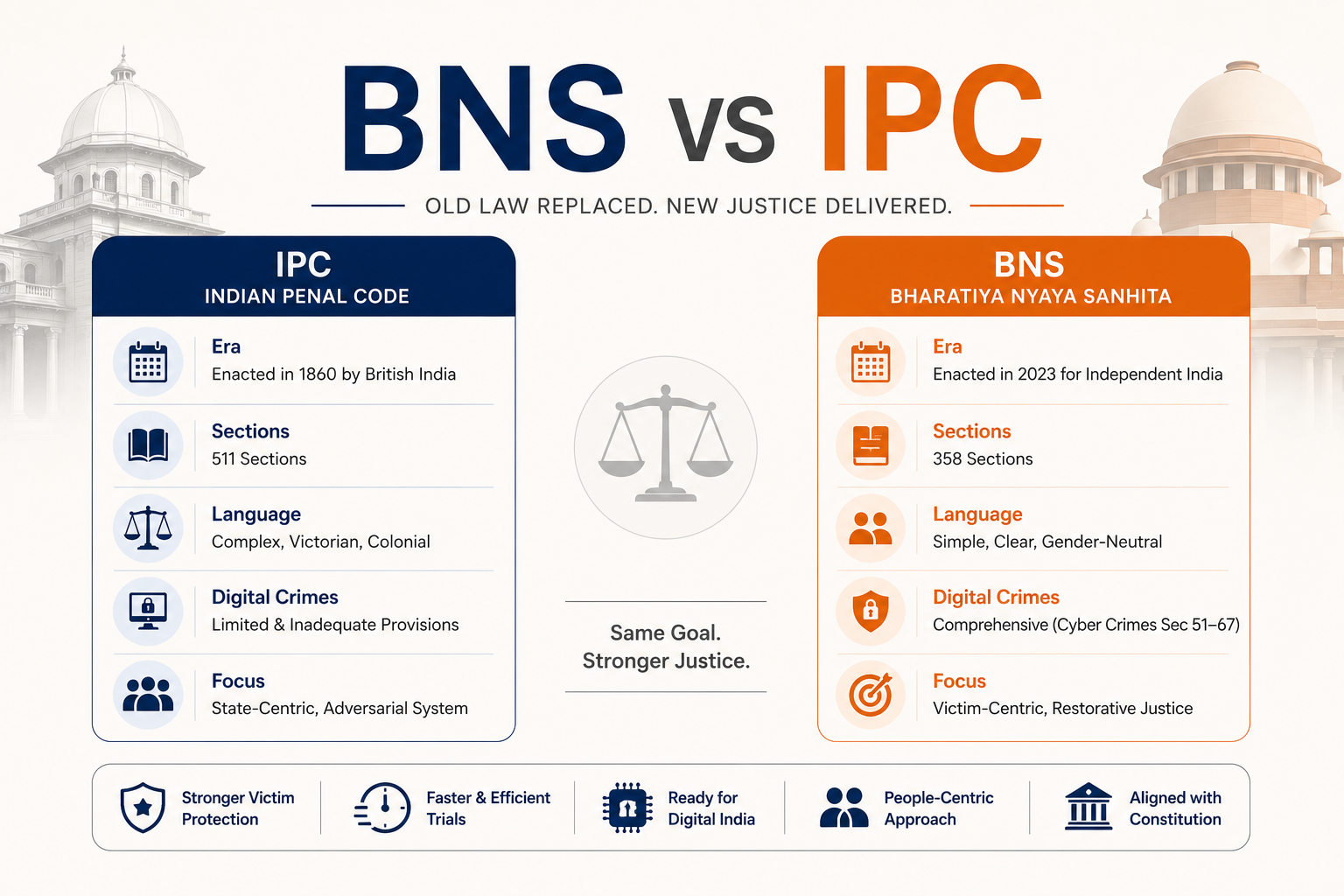
1. Structure & Sections
IPC: 511 sections covering every conceivable crime scenario BNS: 358 sections, reorganized and streamlined
The BNS doesn’t have fewer crimes. It consolidates similar offenses under clearer definitions. For example, several IPC sections on theft are now consolidated into single BNS sections with broader scope.
2. Language & Accessibility
IPC: Dense legal language, Victorian syntax, references to “he” (not gender-neutral) BNS: Plain language, gender-neutral, directly written
Example:
- IPC Section 299: “Culpable homicide is when the act is done with knowledge that it is likely to cause death…”
- BNS Section 100: “Whoever causes death by doing an act with the intention of causing death, or with knowledge that such act is likely to cause death…”
BNS version is shorter, clearer, more direct. No ambiguity.
3. Digital Crimes
IPC: Information Technology Act 2000 had to supplement it. Many digital crimes weren’t clearly defined. BNS: Entire Chapter on “Crime in Cyberspace” (51-67 sections) covering:
- Cyberstalking
- Online fraud
- Data theft
- Hacking
- Deepfakes & synthetic media
- Online harassment
- Digital impersonation
This is massive. Digital crimes are explicitly covered in the criminal code itself.
4. Bail & Procedural Rights
IPC: Bail decisions were discretionary. Bail conditions often harsh. No specific timelines. BNS: Clearer bail provisions. More liberal bail for bailable offenses. Specific timelines for bail decisions (magistrate must decide within 2 hours in many cases).
This means: If you’re arrested under BNS for a bailable offense, you’re more likely to get bail quickly, without excessive conditions.
5. Victim Protection & Rights
IPC: Victim largely absent from the criminal procedure. Victim is just a “witness” to the state’s case. BNS: Victim has explicit rights:
- Right to be informed of case status
- Right to legal representation
- Right to compensation
- Right to be heard during bail hearings
The victim is now a stakeholder, not just a witness.
6. Punishment System
IPC: Rigid sentence structures (“RI for 2-5 years, or fine up to ₹500”) BNS: More flexible, allowing judges to consider circumstances:
- Restorative justice options (community service instead of jail)
- Proportionate punishment
- Enhanced sentencing for aggravated crimes
7. Cognizable vs Non-Cognizable Offenses
IPC: This distinction existed but was confusing. 100+ sections were “cognizable” (police can arrest without warrant).
BNS: Clearer categorization. Fewer offenses are cognizable. This protects citizens from arbitrary police arrest.
What This Means:
- Under IPC, police could arrest you for defamation without a warrant
- Under BNS, police can only arrest you for defamation if a specific procedure is followed (FIR, judicial authorization in many cases)
Detailed Section-Wise Comparison: IPC vs BNS
Let’s compare major offense categories:
Murder & Homicide
| Category | IPC Section | Punishment | BNS Section | Punishment | Change |
|---|---|---|---|---|---|
| Murder | 302 | RI 7 yrs to life | 101 | RI 7 yrs to life | Same |
| Culpable Homicide (not amounting to murder) | 304 | RI 2-8 years | 103 | RI 2-8 years | Same, clearer definition |
| Causing death by negligence | 304-A | RI 2 yrs or fine ₹1,000 | 106 | RI 2 yrs or fine ₹5,000 | Fine increased 5x |
What Changed: Definitions are clearer. Negligence-based death now has higher fine (reflecting inflation, modern values).
Grievous Hurt & Simple Hurt
| Category | IPC Section | Punishment | BNS Section | Punishment | Change |
|---|---|---|---|---|---|
| Voluntarily causing hurt | 323 | RI 3 months or fine ₹250 | 118 | RI 3 months or fine ₹250 | Same |
| Causing grievous hurt | 325 | RI 6 months or fine ₹500 | 121 | RI 6 months or fine ₹500 | Same |
| Using weapon while causing hurt | 332 | RI 6 months or fine ₹250 | 125 | RI 6 months or fine ₹250 | Same |
What Changed: Most hurt provisions remain the same, but BNS clarifies scope and improves victim rights.
Sexual Offenses
This is where the biggest changes happened.
| Offense | IPC Section | Punishment | BNS Section | Punishment | Change |
|---|---|---|---|---|---|
| Rape | 376 | RI 7 yrs to life | 65 | RI 7 yrs to life | Enhanced, more offenses included |
| Rape of child (under 12) | 376-A | RI 10 yrs to life | 66 | RI 10 yrs to life (aggressively prosecuted) | Stricter |
| Sexual harassment | 509 | RI 3 yrs or fine ₹200 | 79 | RI 2 yrs or fine ₹2,000 | More comprehensive definition |
| Stalking | Not clearly defined | — | 74-76 | RI 3 yrs + fine ₹5,000 | Completely new |
Major Addition: BNS has explicit sections on “non-consensual act with sexual intent” (Section 63), which IPC didn’t clearly cover.
Cyber Crimes (BNS ONLY — Not in IPC)
| Offense | BNS Section | Punishment | Didn’t Exist in IPC |
|---|---|---|---|
| Online fraud & cheating | 316 | RI 5 years + fine | Yes |
| Hacking/Data theft | 348 | RI 3 years + fine ₹10 lakhs | Yes |
| Cyberstalking | 351 | RI 5 years + fine ₹20,000 | Yes (partially in IT Act) |
| Non-consensual intimate images (Deepfakes) | 66-C | RI 2 years + fine ₹2,000 | Yes |
| Online impersonation | 318 | RI 3 years + fine ₹5,000 | Yes |
Impact: Digital crimes, which fell into gray areas under IPC + IT Act, now have clear criminal provisions.
Defamation
| Category | IPC Section | Punishment | BNS Section | Punishment | Change |
|---|---|---|---|---|---|
| Defamation | 499-500 | RI 2 years or fine ₹5,000 | 356-357 | RI 2 years or fine ₹5,000 | Same |
What Changed: Still exists but is now a non-cognizable offense in many cases (police can’t arrest without judicial order). Emphasis on civil remedy, not criminal prosecution.
Theft, Cheating & Fraud
| Category | IPC Sections | BNS Sections | Change |
|---|---|---|---|
| Theft | 378-379 | 303-304 | Clearer, covers online theft |
| Cheating | 415-420 | 318-320 | Includes cyber fraud, investment scams |
| Criminal breach of trust | 405-409 | 336-340 | Enhanced for financial crimes |
Change: Cyber-based fraud now explicitly covered. Penalties higher for online schemes.
Why Was the IPC Replaced? (The Real Reasons)
This wasn’t a casual update. There were deep, systemic reasons India needed a new criminal code.
Reason 1: The IPC Was Written in 1860
By 2023, it was 163 years old. Drafted before:
- Electricity existed
- The internet was even imagined
- Women’s rights were recognized in any meaningful way
- Minorities had constitutional protection
- Corporate crime was a thing
The language was colonial. The procedures were adversarial (borrowed from English courts, not Indian values). It simply didn’t fit modern India.
Reason 2: Justice Was Too Slow
Average criminal trial under IPC: 8-10 years.
Witness testimony. Cross-examination. Endless adjournments. Cases were deliberately delayed. By the time a judgment came, the crime’s context had faded. Witnesses had moved. Evidence had degraded.
BNS introduced:
- Stricter timelines (trials should complete within 2-3 years)
- Reduced adjournments
- Digital trial procedures
- Bail-friendly provisions (to reduce pre-trial jail time)
Reason 3: Digital Crimes Weren’t Addressed
A teenager gets cyberstalked. The victim goes to police. Police files a case under IPC Section 506 (criminal intimidation) or IT Act Section 66 (hacking).
But neither law directly addressed online harassment. The IT Act supplemented IPC, creating legal confusion.
BNS has an entire chapter on “Crime in Cyberspace.” Cyberstalking, deepfakes, non-consensual intimate images, hacking — all explicitly defined.
Reason 4: Victim Rights Didn’t Exist
Under IPC, the victim was invisible in criminal procedure. The case was “State vs Accused.” The victim was just Witness #1.
Victims couldn’t:
- Get information about case progress
- Participate in bail hearings
- Request specific witness examination
- Claim compensation as part of the criminal trial
BNS changed this. Victims now have legal rights in criminal trials.
Reason 5: Punishment Didn’t Reflect Modern Values
IPC punishments were set in 1860. A fine of ₹250 for defamation? A fine of ₹200 for sexual harassment? In an era of inflation and crores of fraudulent transactions, these were jokes.
BNS revised fines to reflect modern economic reality. Cyber fraud now carries ₹10 lakh fine (vs unclear IT Act penalties). Online harassment now carries ₹20,000 fine (vs ₹200 under IPC).
How Did This Transition Happen? (The Timeline)
2020: Government appoints committee to draft new criminal code 2022: Draft BNS published for public comments December 2022: BNS becomes law (Parliament passage) July 1, 2023: BNS comes into force. IPC is repealed.
But here’s the thing: It wasn’t a sudden switch.
For ongoing cases (filed under IPC before July 1, 2023):
- Old cases continue under IPC until conviction/acquittal
- No retroactive change (for fairness)
- But some procedural improvements apply to ongoing cases
For new cases (filed after July 1, 2023):
- All cases filed under BNS
- New procedures apply
- Victims have rights
This phased approach prevented chaos. Courts didn’t have to restart thousands of cases.
How Does BNS Affect You Personally?
Whether you’re accused of a crime, a victim, or just a citizen:
If You’re Accused Under BNS
Good News:
- Clearer charges (less ambiguity about what you’re accused of)
- Faster bail decisions (2-hour magistrate timeline)
- Non-cognizable offenses protect you from arbitrary arrest
- Digital evidence rules are explicit (can’t use illegally obtained digital evidence)
Bad News:
- Digital crimes have stricter penalties
- Cyber-based fraud carries ₹10 lakh fine (vs lower under IPC)
- Sexual offense definitions are broader
If You’re a Victim
Good News:
- You have legal rights (information, representation, compensation)
- Faster trials (3-year target vs 8-year average)
- Better victim protection for sexual offenses, domestic violence
- Compensation can be awarded as part of criminal trial
Bad News:
- Some offenses are now non-cognizable (police won’t arrest automatically)
- You may need to push for prosecution yourself
If You’re a Lawyer
Good News:
- Fewer sections to master (358 vs 511)
- Clearer procedure
- More opportunities in cyber crime cases
Bad News:
- Need to reskill (learn new BNS procedures)
- Old case precedents may not directly apply
- Courts are still interpreting BNS (some confusion initially)
FAQ: BNS vs IPC Questions Answered
Q1: Is the BNS completely replacing the IPC, or do both exist?
The IPC is completely repealed. BNS is the only criminal code. However, cases filed under IPC before July 1, 2023 continue under IPC until conclusion. Going forward, all criminal cases use BNS.
Q2: Can a case under BNS be quashed based on IPC precedents?
Partially. BNS precedents are new (post-July 2023). If BNS section is identical to old IPC section, past judgments are persuasive but not binding. Courts are still establishing BNS jurisprudence.
Q3: Which is easier to prosecute/defend — IPC or BNS?
BNS is generally more favorable to accused (non-cognizable offenses, quicker bail). For prosecution, BNS is clearer on digital crimes. For victims, BNS is far better (victim rights, faster trials).
Q4: Do BNS punishments match IPC?
Mostly yes for violent crimes (murder, rape, theft). But cyber crimes have new, higher punishments. Fines have been revised across the board (generally increased 2-5x).
Q5: Can a case pending since 2020 be converted to BNS?
No. Ongoing cases continue under IPC. But procedural improvements (like bail liberalization) may apply. Courts have discretion.
Q6: Is BNS applied differently in different states?
No. BNS is uniform across India. It’s a central law. All courts, police, and legal institutions follow the same BNS provisions. However, state-specific laws (e.g., Prevention of Atrocities Act) continue to apply separately.
Q7: What happens if someone was convicted under IPC but now their crime would be non-cognizable under BNS?
The conviction stands. The past doesn’t change. But if they’re under appeal or in post-conviction proceedings, BNS procedures may apply to those new proceedings.
Q8: Are digital crimes much harsher under BNS?
Yes, generally. BNS explicitly criminalizes many digital offenses that were gray areas under IPC + IT Act. Penalties are also higher to reflect modern values.
Q9: Does BNS remove the death penalty?
No. Murder (Section 101) still carries death penalty option. No change.
Q10: Which is better for victims — IPC or BNS?
BNS is dramatically better for victims. Victims have explicit rights, faster trials, compensation options, and better protection under BNS.
Major Changes in Specific Areas
1. Online Harassment & Cybercrime
Under IPC:
- IT Act Section 66 covered hacking
- IPC Section 506 covered intimidation
- Cyberstalking wasn’t explicitly a crime
Under BNS:
- Explicit section on cyberstalking (351) — RI 5 years + fine ₹20,000
- Explicit section on non-consensual intimate images (66-C) — RI 2 years
- Online fraud explicitly covered (316) — RI 5 years + fine
Impact: Someone who posts intimate photos of you online without consent is now clearly a criminal under BNS. Under IPC, the legal route was unclear.
2. Defamation & Free Speech
Under IPC:
- Defamation was cognizable (police could arrest you)
- Section 499-500: RI 2 years or fine ₹5,000
- News publications got no special protection
Under BNS:
- Defamation is now non-cognizable (police can’t arrest)
- Section 356-357: Same punishment, but civil route preferred
- Journalists and publications have explicit exemptions
Impact: Journalists have more freedom. Citizens can’t be arrested for mere defamation. More protection for free speech.
3. Domestic Violence & Sexual Abuse
Under IPC:
- Provisions scattered across multiple sections (498-A for cruelty, rape definitions were narrow)
Under BNS:
- Consolidated provisions with expanded definitions
- Better victim protection
- Enhanced penalties for child sexual abuse
4. Bail & Arrest Rights
Under IPC:
- Bail was discretionary for bailable offenses
- Many non-serious crimes were cognizable (police could arrest)
- Bail conditions often harsh
Under BNS:
- Bail presumed for many offenses
- Fewer cognizable crimes (police can’t arrest)
- Bail decision timeline: 2 hours (must inform you of bail conditions)
- Bail conditions must be proportionate
Impact: You’re less likely to be arrested for minor offenses. Bail is more easily granted.
How Courts Are Interpreting BNS (As of 2026)
Early BNS cases (2023-2025) showed courts taking a victim-friendly, pragmatic approach:
- Bail Liberality: Courts have granted bail liberally in bailable offenses, especially white-collar crimes
- Cyber Crime Severity: Courts treat cyber crimes seriously (hacking, fraud treated harshly)
- Victim Rights: Courts ensure victims are informed and participate in bail hearings
- Procedural Flexibility: Courts are interpreting BNS to speed up trials (rejecting frivolous adjournments)
However, some contradictions remain. Some courts still reference IPC precedents. This will settle once high courts issue binding BNS interpretations.
Practical Advice: If You’re Dealing with a Criminal Case
If You’re Accused
- Understand Your Charges: Get the exact BNS section. IPC-era precedents may not apply.
- Bail Strategy: BNS is bail-friendly. Apply for bail immediately (2-hour deadline for magistrate decision).
- Digital Evidence: If your case involves digital evidence, BNS has specific rules. Illegal evidence is excluded.
- Hire a BNS-Competent Lawyer: Ensure your lawyer understands BNS (not just IPC).
If You’re a Victim
- Assert Your Rights: You have explicit rights under BNS (information, representation, compensation).
- Hire a Lawyer: A good lawyer can ensure your rights are protected during prosecution.
- Faster Justice: BNS promises faster trials. Hold courts to that standard.
- Compensation Claim: Claim compensation as part of the criminal trial (don’t wait for civil case).
If You’re a Lawyer
- Reskill: Learn BNS procedures, especially digital crime provisions.
- Cyber Crime Niche: Huge opportunity in cyber crime practice (new area, growing demand).
- Client Education: Clients don’t understand BNS yet. Educating them is valuable.
- Procedural Knowledge: Know BNS bail procedures, evidence rules, trial timelines cold.
Conclusion: IPC to BNS Is India Growing Up
The transition from IPC to BNS isn’t just a legal update. It’s India acknowledging that 163-year-old colonial law doesn’t fit a modern, digital democracy.
BNS is faster. It’s victim-friendly. It addresses cyber crime. It reflects constitutional values of 1950 (not 1860 colonial assumptions).
But BNS isn’t perfect. Courts are still interpreting it. Some contradictions exist. But the direction is clear: Justice will be faster. Crime will be more precisely defined. Digital offenses will no longer fall through legal cracks.
If you’re dealing with any criminal matter — as accused, victim, or professional — understand that the rules have changed. The old IPC playbook doesn’t work anymore. BNS is a new game with new rules.
At Adv. Pooja Agrawal & Associates, we specialize in navigating both IPC (for ongoing cases) and BNS (for new cases). We understand the nuances, the procedural changes, the victim rights, the bail strategies.
Whether you’re facing charges under BNS or seeking justice as a victim, we’re here to guide you through India’s new criminal justice system.
Contact Information
Adv. Pooja Agrawal & Associates Specializing in Criminal Law & Victim Rights | Delhi NCR
Contact Form – advocatepooja.com/contact
Phone –+9199204 56025
Office Address – Office No. 2 & 3,Ground Floor,Shrishti CHS Ltd,Plot No. 96,Sector-27.Opp.Dr. Sonawane Orthopaedic Hospital,Seawood(E),Navi Mumbai-400706.
Learn how BNS affects your case. Schedule a consultation today.