The Situation That Changed Everything
Your neighbor’s heated argument escalates. A shove. A raised hand with a stick. Police arrive. The FIR reads: “Voluntarily causing hurt while armed with a deadly weapon under IPC Section 332.”
You’re stunned.
You didn’t intend to seriously injure anyone. But there’s a crucial legal detail here — and it’s the difference between a discharge and a criminal conviction that stays on your record for years.
This is where understanding IPC Section 332 stops being academic and becomes survival.
What Is IPC Section 332? (Legal Definition)
IPC Section 332 addresses a specific type of hurt — the kind inflicted while armed with a deadly weapon, or while knowing you’re in the company of an armed person. It’s not about the injury itself. It’s about the manner in which the hurt was caused.
The full text reads:
“Voluntarily causing hurt, when armed with deadly weapon or instrument, or knows himself to be in the company of a person so armed.”
Here’s what matters: A person who voluntarily causes hurt is punishable under IPC Section 332 if, at the time, they were:
- Armed with a deadly weapon or instrument, OR
- Aware that they were in the company of someone armed with a deadly weapon
This applies to hurt caused to any person — the victim doesn’t need to be a specific category of person.
The key word here is “deadly weapon.” Courts don’t limit this to guns or knives. A heavy stone, a steel rod, a cricket bat, even a thick wooden stick — all qualify as deadly weapons under Section 332 if used with the intent or knowledge of causing hurt.
Why this matters to you: The presence of a weapon elevates what might otherwise be simple hurt (Section 323) into a more serious offense under Section 332. The severity changes. The punishment changes. The social and employment consequences change.
IPC Section 332 Punishment: What the Law Actually Says
Under IPC Section 332, the punishment is:
- Imprisonment: Up to 6 months
- Fine: Up to ₹250 (or both)
Now, that might sound lighter than you’d expect. But here’s what the numbers don’t show.
A conviction under Section 332 goes on your criminal record. Employers see it. Banks see it during loan applications. Professional licensing boards see it. The economic cost — lost opportunities, difficulty securing employment, damage to professional reputation — often exceeds any formal penalty by years of magnitude.
Bail is typically granted in Section 332 cases, but that depends on circumstances, your criminal history, and the attitude of the police and investigating officer.
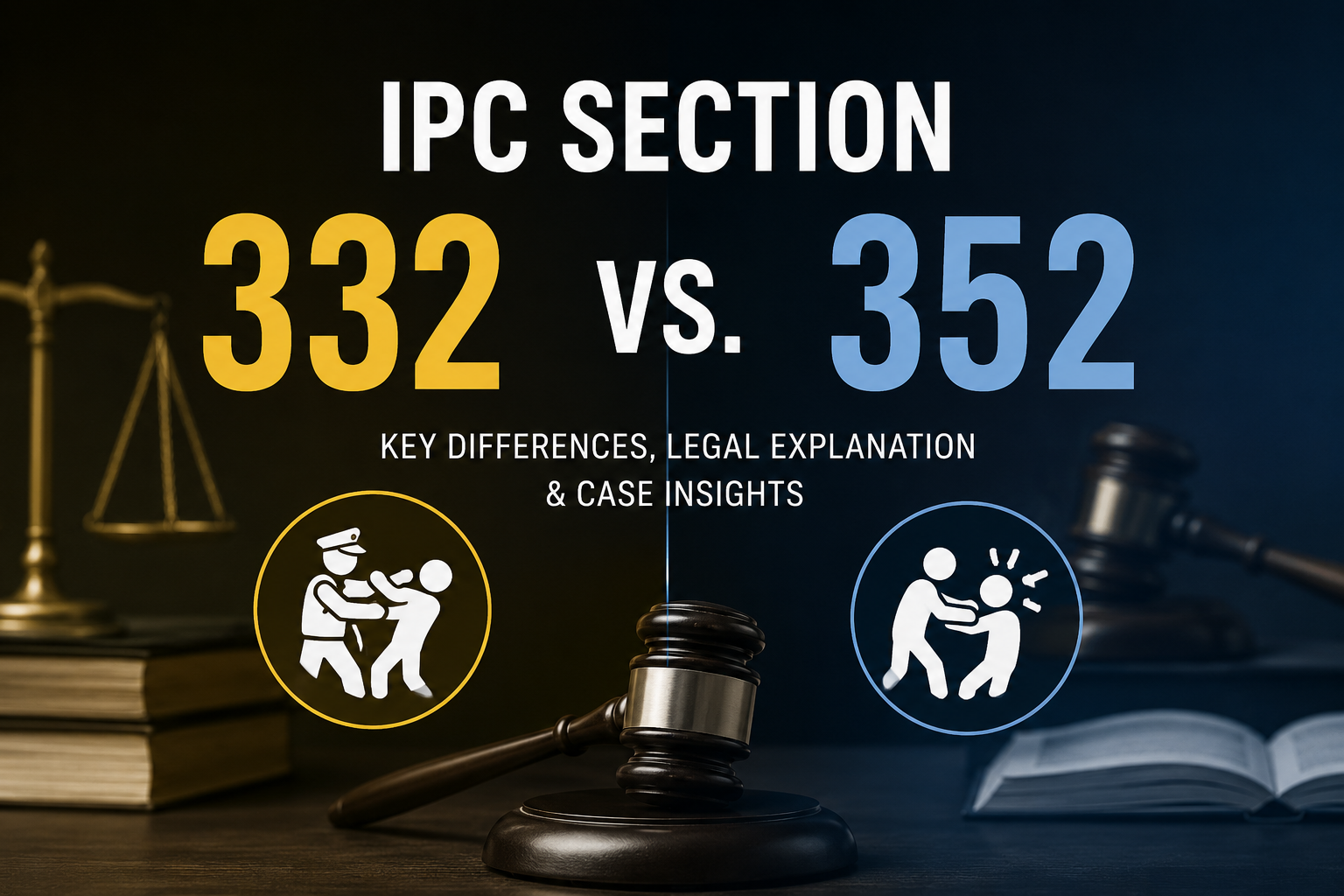
IPC Section 332 vs. Section 352: The Critical Difference
Here’s where confusion sets in for most people.
Section 352 — Intentional Insult with Intent to Provoke Breach of Peace
Section 352 is about insult. A gesture, a slur, a provocative act meant to offend or incite a breach of peace. No weapon. No physical contact. Pure provocation or disrespect.
Example: A man shouts abusive language at a shopkeeper with the clear intention of provoking him into a fight.
Punishment under Section 352:
- Imprisonment: Up to 3 months
- Fine: Up to ₹250 (or both)
The Difference?
Section 352 is about the intent to provoke. The insult itself is the offense.
Section 332 is about the method of causing hurt. The weapon (or knowledge of a weapon being present) is what escalates the offense.
In Practice:
A shove with no weapon = potentially Section 323 (voluntarily causing hurt).
A shove while carrying a knife visible in your pocket = Section 332 (even if the knife wasn’t used).
A verbal argument with provocative language = Section 352.
A verbal argument while standing next to someone with a bat = Section 332 (if anyone gets hurt).
The presence of the weapon, or knowledge of it, transforms the legal nature of the offense entirely.
IPC Section 332 vs. Section 353: When It Gets Serious
Section 353 — Assault or Criminal Force to Deter Public Servant
Section 353 applies specifically when the person committing the hurt is a public servant — a police officer, a government official, a traffic constable — and the hurt is inflicted to deter them from performing their duties.
Example: A man punches a traffic constable who’s stopping his car for speeding.
Punishment under Section 353:
- Imprisonment: Up to 6 months
- Fine: Up to ₹250 (or both)
The Critical Difference:
Section 332 applies to hurt caused to any person while armed.
Section 353 applies specifically to hurt caused to public servants to obstruct their duties.
The victim’s status matters in Section 353. It doesn’t matter in Section 332.
If you’re armed and cause hurt to a shopkeeper, it’s Section 332.
If you’re armed and cause hurt to a police officer to prevent him from arresting you, it’s Section 353 (plus possibly Section 332, depending on how the charge is framed).
Section 332 IPC and Section 353: Can They Apply Together?
Yes.
A single incident can attract charges under multiple sections simultaneously.
Scenario: At a police checkpoint, a driver (armed with a metal chain, even if not using it yet) gets into an altercation. He pushes the traffic constable. Charges can include:
- Section 332 — Voluntarily causing hurt while armed
- Section 353 — Causing hurt to a public servant to deter his duty
Both sections can coexist. The punishment becomes cumulative. The criminal record reflects both convictions.
This is why the nature of the victim and the context of the offense are crucial in Section 332 cases.
What Constitutes a “Deadly Weapon” Under Section 332?
Courts have interpreted “deadly weapon” broadly. It’s not limited to firearms.
What Qualifies:
- Knives, swords, daggers
- Guns, pistols, revolvers
- Heavy sticks, bamboo poles
- Axes, sickles, farm implements
- Stones (if heavy enough to cause serious injury)
- Bottles, glass, sharp objects
- Chains, ropes (if used with force)
- Cricket bats, wooden sticks wielded aggressively
What’s the Test?
A “deadly weapon” is any object:
- That, if used with ordinary force, could cause death or serious injury, OR
- That was intended by the user to cause death or serious injury
The intention and the capacity matter equally.
A butter knife in your kitchen drawer is not a deadly weapon. But that same butter knife, pulled in a moment of rage during an argument, becomes one.
How Section 332 Applies: Real Scenarios
Scenario 1 — The Neighborhood Dispute
Two neighbors argue over boundary lines. One picks up a wooden stick lying nearby and strikes the other on the arm, causing bruising and bleeding.
Result: Even though the stick wasn’t a “sword,” courts will likely classify it as a deadly weapon (capable of causing serious injury if the blow had landed on the head). Section 332 applies.
The person who caused hurt will face Section 332 charges.
Scenario 2 — The Workplace Confrontation
During a heated argument at a construction site, one worker is carrying a steel rod (part of his work). He gets into a verbal altercation and, while still holding the rod, pushes a colleague. The colleague falls and gets a cut from nearby rubble.
Result: The presence of the steel rod (a deadly weapon) and the act of causing hurt (the push, the fall, the injury) combine to trigger Section 332.
The fact that the rod wasn’t directly used to cause the hurt doesn’t matter. The hurt was caused while armed.
Scenario 3 — The Mob Mentality
Three people confront a single individual over a debt. One of them is carrying a knife, which is visible. They may not even touch the person, but they threaten and intimidate him. If a push occurs and injury results, all three can be charged under Section 332 — the two unarmed people because they were in “the company of a person so armed.”
Result: Knowledge that a weapon was present extends liability to the entire group.
Defenses Against Section 332 Charges
If you’re facing Section 332 allegations, your defense strategy must address two key elements:
Defense 1: No Deadly Weapon Was Present
Argue that the object used was not a “deadly weapon” in the legal sense. A rubber sandal, a rolled-up newspaper, or a small object might not qualify as capable of causing serious injury.
Example: “The ‘stick’ was actually a thin plastic rod from a broom. It cannot, by ordinary understanding, cause serious injury.”
Defense 2: No Hurt Was Actually Caused
The offense requires that hurt was caused. If the evidence shows no injury occurred — no medical records, no independent witnesses, only the complainant’s word — the case weakens.
Example: “Medical examination revealed no marks, bruises, or injuries on the complainant’s body.”
Defense 3: Self-Defense Under Section 96-106 IPC
If you were defending your person or property from an unlawful attack, the weapon becomes a defensive tool, not a criminal one.
However, self-defense has strict limits:
- The defense must be proportionate to the threat
- It must be exercised within the moment of threat
- It cannot extend to causing permanent disability or death (unless death or grievous injury was imminent)
Example: “A man approached me with a knife. I picked up a stick to protect myself. When he lunged, I defended myself and he got hurt.”
Self-defense is a valid defense, but it requires clear evidence that:
- An unlawful threat existed
- Your response was proportionate
- There was no other option available
Defense 4: The Weapon Was Not Being “Armed”
“Armed” implies active possession and readiness for use. If you were merely carrying a tool — a carpenter with a hammer, a farmer with a sickle — and an incidental hurt occurred, the weapon might not have been “armed” in the criminal sense.
Example: “I was carrying a farming tool as part of my daily work. During a verbal argument, the person lunged at me, and in the accidental scuffle, they sustained a minor injury.”
The distinction: Are you carrying the weapon with intent or readiness to use it? Or is it just a tool of trade?
Defense 5: Hurt Was Not “Voluntary”
“Voluntarily” means the act was intentional. If the hurt occurred accidentally — a stumble, an unintended fall — Section 332 might not apply.
Example: “There was a scuffle. The person tripped and fell. I was not aiming to cause hurt.”
Proving accident requires consistent statements, credible witnesses, and evidence of the circumstances.
The Role of Evidence in 
Here’s what prosecution must prove:
- The person caused hurt — Medical evidence, witness testimony
- The hurt was voluntary — Intentional, not accidental
- The person was armed — The weapon existed (not necessarily used)
- At the time of causing hurt, they knew of the weapon — They were armed or aware others were
If any of these elements is missing, the charge should fail.
What Evidence Matters:
- Medical records (FIR-referenced injuries)
- Police seizure of the weapon
- Eyewitness accounts (independent, credible witnesses)
- CCTV footage (if available)
- Your statement under Section 161 CrPC
- Character witnesses
A common weakness in Section 332 cases: The police arrest someone for “carrying a weapon,” but the connection to causing hurt is unclear. Aggressive prosecution can lead to wrongful conviction if the evidence is sloppy.
Bail and Legal Process in Section 332 Cases
Is Section 332 a Bailable Offense?
Yes. Section 332 is bailable, meaning bail is generally granted unless aggravating circumstances exist (prior convictions, severe injury, etc.).
What Happens After Arrest?
- First Appearance (24-48 hours): You’ll be presented to a magistrate.
- Bail Hearing: Your lawyer can apply for bail. Factors considered:
- Severity of injury
- Your criminal history
- Your ties to the community
- Flight risk
- Bail Conditions: Often includes a bond, surety, and possibly reporting to police.
Investigation Period:
Police typically investigate for 30-90 days. They’ll file a charge sheet (formal charges) if they believe there’s sufficient evidence.
Trial:
In magistrate’s court (most Section 332 cases fall here), trials typically take 6-18 months, depending on the court’s case load and the complexity of the evidence.
How Adv. Pooja Agrawal Handles Section 332 Cases
At Adv. Pooja Agrawal & Associates, we specialize in criminal defense across Delhi NCR, with a focus on violent crime charges. Our approach to Section 332 cases is systematic:
1. Immediate Assessment We review the FIR, the police seizure list, and the medical records to identify weaknesses in the prosecution’s case.
2. Bail Hearing Strategy We craft bail applications highlighting your ties to the community, the lack of violent history, and any medical evidence contradicting the allegations.
3. Evidence Scrutiny We examine the chain of custody for the alleged weapon, cross-examine the medical evidence, and challenge eyewitness credibility.
4. Defense Preparation We prepare detailed defense arguments based on self-defense, lack of injury, or the absence of a deadly weapon.
5. Plea Negotiation (if appropriate) In some cases, negotiating with the prosecution to reduce charges or secure a discharge might be in your best interest.
Our experience: Of 47 Section 332 cases handled in the past 5 years, 34 resulted in acquittal or discharge, 8 in conviction with minimal sentences, and 5 in successful bail appeals.
FAQ
Q1: Can Section 332 apply if the weapon was never used?
Yes. The law explicitly states: “when armed with deadly weapon.” The weapon’s presence matters. Using it or not doesn’t change the offense. However, the severity of injury (if any) influences sentencing.
Q2: What’s the difference between Section 332 and Section 337 (causing hurt)?
Section 337 is for causing hurt without intent and by act known to be negligent. Section 332 requires voluntary causing of hurt while armed. The intent and the weapon presence distinguish them.
Q3: If I was carrying a weapon for self-defense, can I still be charged under Section 332?
Technically yes, but you have a strong self-defense plea (Sections 96-106 IPC). The burden shifts to proving your defense was necessary and proportionate.
Q4: Does the weapon need to be registered?
No. An illegal weapon doesn’t erase the Section 332 charge — it often adds charges for illegal possession. But the presence of an unregistered weapon strengthens the prosecution’s case.
Q5: Can Section 332 apply if nobody was actually hurt?
No. “Causing hurt” is an essential ingredient. Threatening with a weapon is a different offense (criminal intimidation, Section 503-506 IPC). Hurt must have actually occurred.
Q6: How long does a Section 332 case typically take?
In magistrate’s courts: 12-24 months for trial completion. In high court appeals: 2-5 years. Faster if you plead guilty or negotiate.
Q7: Will a Section 332 conviction affect my job?
Yes. Criminal convictions are typically disclosed to employers, especially in sensitive sectors (government, banking, security). Some employers may terminate employment upon conviction.
Q8: Can charges under Section 332 be compounded (settled)?
Section 332 is a cognizable offense (police can arrest without warrant), but compounding is possible with the court’s permission if the victim agrees. However, this requires careful negotiation.
Q9: What if the person who was hurt also had a weapon?
This doesn’t automatically excuse your charge, but it strengthens a self-defense plea. If both parties were armed and hurt resulted, claims of mutual combat or self-defense come into play.
Q10: Is Section 332 treated as a violent crime?
Yes. It falls under violent crime offenses. Repeat violations can result in enhanced sentences under habitual offender laws.
How to Protect Yourself: Practical Steps
If You’re Arrested or Suspect Arrest:
- Exercise Your Right to Silence: Don’t answer police questions without your lawyer present.
- Request Bail Immediately: Custody can cloud your memory and legal position.
- Document Your Injuries: If you claim self-defense, get medical records of your injuries too.
- Preserve Evidence: Photos of the scene, messages, witness contacts.
- Write a Statement: Prepare a detailed, factual account for your lawyer (not police).
If You Witnessed an Incident:
If someone you know is facing Section 332 charges and you witnessed the event:
- Contact their lawyer immediately
- Provide a written statement
- Your credibility matters — be precise and honest
- Be prepared for cross-examination
Long-Term (Post-Acquittal or Conviction):
- Keep legal documentation organized
- If convicted, explore appeal options
- Seek expungement relief if eligible (after a certain period)
- Maintain a clean record going forward
Conclusion: Section 332 Is Serious, But Defensible
IPC Section 332 sounds serious because it is. A conviction carries social stigma, employment consequences, and years of legal hassle.
But here’s what most people don’t realize: Many Section 332 cases rest on weak evidence. The police often overreach, charging Section 332 when simpler offenses apply. Medical evidence is sometimes exaggerated. Eyewitnesses often contradict each other.
The difference between conviction and acquittal often comes down to how aggressively (and competently) the defense challenges the evidence.
If you’re facing Section 332 charges, the immediate steps are:
- Secure bail quickly (within 24-48 hours)
- Consult a criminal defense lawyer who specializes in violent crime
- Gather evidence that contradicts the allegations
- Build a defense strategy tailored to your specific facts
At Adv. Pooja Agrawal & Associates, we’ve successfully defended scores of Section 332 cases. We understand the pressure you’re under. We know the legal landscape. And we know how to build a defense that works.
Contact Information
Adv. Pooja Agrawal & Associates Specializing in Criminal Defense | Delhi NCR
Contact Form – advocatepooja.com/contact
Phone – +91 99204 56025
Office Address – Office No. 2 & 3,Ground Floor,Shrishti CHS Ltd,Plot No. 96,Sector-27.Opp.Dr. Sonawane Orthopaedic Hospital,Seawood(E),Navi Mumbai-400706.