
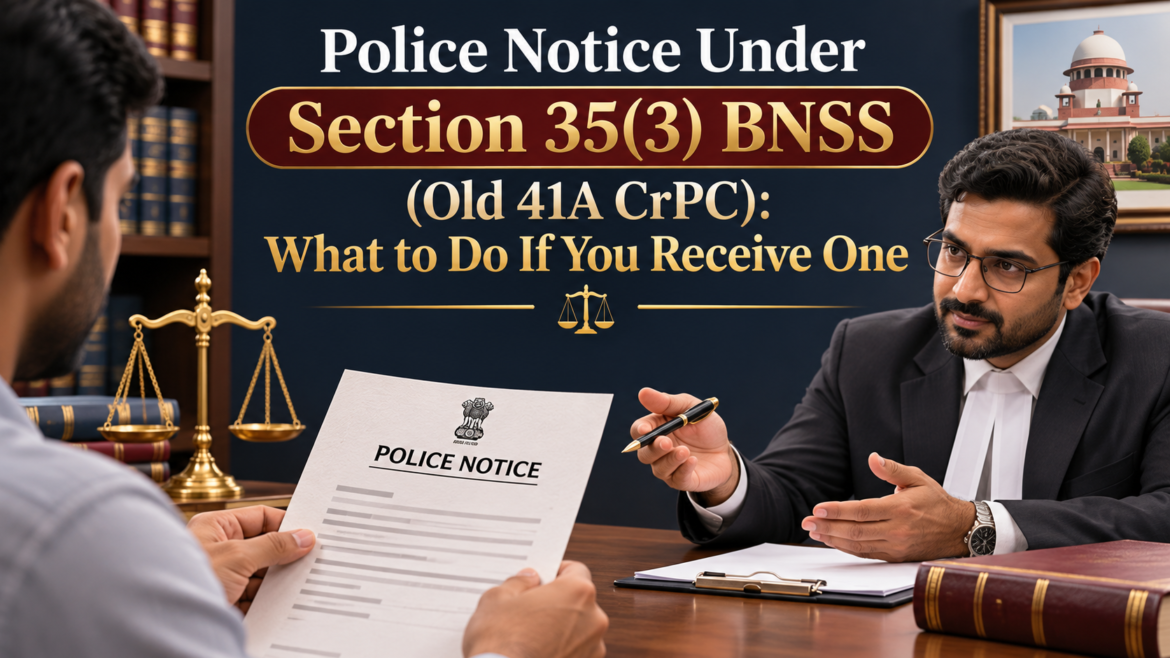
What Is a Section 35(3) BNSS Notice?
A Section 35(3) BNSS notice is a written police notice that asks you to appear before a police officer, or at another place named in the notice, in connection with a cognizable offence. Police issue it when your arrest is not required. If you comply with it and keep complying, the police cannot arrest you for that offence unless they record written reasons. Section 35(3) of the Bharatiya Nagarik Suraksha Sanhita, 2023 (BNSS) replaces Section 41A of the old CrPC.
Receiving a police notice can be frightening, especially if you have never dealt with the police before. The good news is that a Section 35(3) notice is not an arrest. It is a call to join the investigation. How you respond to it, however, can decide whether the matter stays a simple inquiry or turns into an arrest. This guide explains what the notice means, your rights and the exact steps to take.
What Is Section 35 BNSS?
Section 35 of the BNSS deals with when the police may arrest a person without a warrant. It came into force on 1 July 2024, when the BNSS replaced the Code of Criminal Procedure, 1973. It sets the conditions for arrest without a warrant and, just as importantly, the cases where the police must issue a notice instead of arresting.
| Sub-section | What it says (in simple words) |
|---|---|
| 35(1) | Lists the situations in which police may arrest without a warrant. For offences punishable with up to 7 years, the officer must have reason to believe the person committed the offence and that arrest is necessary, for example to prevent another offence, for proper investigation or to stop tampering with evidence or witnesses. |
| 35(3) | Where arrest is not required, the police officer shall issue a notice asking the person to appear before him or at a specified place. |
| 35(4) | The person who receives the notice has a duty to comply with its terms. |
| 35(5) | If the person complies and continues to comply, he shall not be arrested for that offence, unless the officer records reasons why arrest is necessary. |
| 35(6) | If the person fails to comply or refuses to identify himself, the officer may arrest him for the offence in the notice, subject to any court orders. |
| 35(7) | For offences punishable with less than 3 years, a person who is infirm or above 60 years cannot be arrested without prior permission of an officer not below the rank of Deputy Superintendent of Police (DSP). |
Section 35 BNSS in CrPC: Old vs New Law
Many people still search for “Section 35 BNSS in CrPC” because the police, courts and lawyers used the old CrPC numbers for decades. Here is how the provisions match:
| Subject | Old CrPC, 1973 | New BNSS, 2023 |
|---|---|---|
| Arrest without warrant | Section 41 | Section 35(1) and 35(2) |
| Notice of appearance before police | Section 41A | Section 35(3) to 35(6) |
| Protection for elderly or infirm persons in minor offences | No equivalent | Section 35(7) (new) |
The core idea is the same as in Section 41A CrPC. The BNSS adds a new safeguard for senior citizens and infirm persons under Section 35(7).
What Is a Police Notice and What Does It Contain?
In simple terms, a police notice under BNSS is a written direction from the police to a person to appear for questioning or to cooperate with an investigation. A Section 35(3) notice is usually a printed format filled in by the investigating officer. It normally contains:
- Your name and address
- The FIR number, police station and the sections of the offence
- The date, time and place where you must appear
- The conditions you must follow, such as not committing any further offence, not tampering with evidence, not threatening witnesses, appearing whenever required and producing documents if asked
- A warning that failure to comply may lead to arrest under Section 35(6) BNSS
- The name, rank and signature of the investigating officer
Ask for a copy of the notice, or keep the copy given to you. You will need it when you meet your lawyer.
What Is Section 35 Police: When Is a Notice Issued?
When people ask “what is Section 35 police”, they usually mean the police power under Section 35 BNSS to either arrest or issue a notice. For offences punishable with imprisonment of up to 7 years, such as many cheating, criminal breach of trust, hurt, defamation, cyber and matrimonial cases, the notice is the normal route.
In Satender Kumar Antil v. CBI (15 January 2026), the Supreme Court held that for offences punishable with up to 7 years, a notice under Section 35(3) BNSS is the rule and arrest is the exception. The Court said:
- Arrest is not automatic. Even when the conditions for arrest are met, the officer must first ask whether arrest is really necessary.
- Reasons must be recorded. The officer must record reasons in writing both for arresting and for not arresting.
- A person who complies cannot be arrested for that offence under Section 35(5), unless the officer records valid reasons.
- Arrest after a notice needs fresh material. If the police later want to arrest a person who was given a notice, the arrest must be based on new material that was not available when the notice was issued. Non-compliance alone does not automatically justify arrest.
This judgment builds on the earlier Arnesh Kumar v. State of Bihar (2014) guidelines, which aimed to stop routine arrests in offences punishable with up to 7 years.
How Must a Section 35(3) BNSS Notice Be Served?
A Section 35(3) notice must be served through the modes recognised by law, which usually means it is delivered to you physically. In Satender Kumar Antil v. CBI (order dated 16 July 2025), the Supreme Court rejected the State of Haryana’s request to allow service by WhatsApp or email. The Court held that electronic communication is not a valid mode of serving a Section 35 BNSS notice, because failing to comply can cost a person their liberty.
So if you have only received a WhatsApp message, SMS or email asking you to come to the police station, do not ignore it, but speak to a lawyer. It is not a valid Section 35(3) notice, and your lawyer can respond to the police in the correct way.
What to Do If You Receive a Section 35(3) BNSS Notice
- Stay calm and read the notice carefully. Note the FIR number, the sections, the police station and the date and time of appearance.
- Check how it was served. Confirm that you received a proper written notice, not just a phone call or WhatsApp message.
- Contact a criminal lawyer immediately. A lawyer can obtain the FIR, understand the allegations and advise you before you appear.
- Collect your documents. Keep identity proof, the notice and any papers that support your side, such as agreements, payment records, messages or emails.
- Appear on the date given. Compliance is your strongest protection under Section 35(5). If you genuinely cannot appear on that date, have your lawyer request a new date in writing in advance and keep proof of the request.
- Cooperate, but know your rights. Answer questions truthfully. You are not required to make statements that incriminate you, and you should not sign any statement you have not read and understood.
- Follow every condition in the notice. Do not contact the complainant or witnesses, do not tamper with evidence and appear again whenever required.
- Consider anticipatory bail if you fear arrest. If the facts suggest the police may still arrest you, your lawyer can apply for anticipatory bail under Section 482 BNSS before the Sessions Court or High Court.
Your Rights When You Receive a Police Notice Under BNSS
- Right to know the case: you can ask for the FIR number and the sections involved. Your lawyer can obtain a copy of the FIR.
- Right to legal advice: you can consult a lawyer before appearing, and you can take your lawyer with you to the police station. Whether the lawyer can sit in during questioning depends on the police and any court order.
- Right against self-incrimination: under Article 20(3) of the Constitution, you cannot be compelled to be a witness against yourself.
- Protection from arrest on compliance: under Section 35(5) BNSS, if you comply and continue to comply, you cannot be arrested for that offence unless the officer records written reasons.
- Proper service: the notice must be served through legal modes, not WhatsApp or email.
- Extra protection for senior citizens: for offences punishable with less than 3 years, a person above 60 or infirm cannot be arrested without prior permission of an officer of DSP rank or above, under Section 35(7).
What Happens If You Ignore a Section 35(3) Notice?
Ignoring the notice is the biggest mistake you can make. Under Section 35(6) BNSS, if you fail to comply with the notice or refuse to identify yourself, the police officer may arrest you for the offence mentioned in the notice, subject to any order passed by a court.
Courts have said that non-compliance does not lead to arrest automatically, and the police must still show that arrest is necessary. Still, not appearing gives the police a reason to consider arrest and weakens your case if you later seek bail. Repeated non-appearance can also lead the court to issue a warrant later in the case.
Common Mistakes to Avoid
- Ignoring the notice because you think the case is false
- Going to the police station without first speaking to a lawyer
- Signing a statement without reading it or without understanding it
- Contacting the complainant or witnesses to “settle” the matter on your own
- Deleting messages, emails or documents connected to the case
- Missing the appearance date without informing the police in writing
How Advocate Pooja Can Help
A Section 35(3) notice is often the first step in a criminal case. The way it is handled can decide whether you stay free while the investigation continues. Adv. Pooja Agrawal & Associates, based in Seawood (E), Navi Mumbai, advises clients on police notices, FIRs and bail under the new criminal laws.
- Review of the notice and FIR, and advice before you appear
- Checking whether the notice was issued and served correctly
- Written replies and requests for a new date of appearance
- Guidance on your rights during questioning
- Anticipatory bail and regular bail applications under the BNSS
- Representation in quashing petitions where the case is false or civil in nature
Visit advocatepooja.com to book a consultation.
Frequently Asked Questions (FAQs)
- What is notice under section 35(3) of BNSS?
It is a written notice from the police asking a person to appear before the police officer, or at another specified place, in connection with a cognizable offence where arrest is not required. It replaces the notice under Section 41A of the CrPC. If the person complies and keeps complying, he cannot be arrested for that offence unless the officer records reasons.
- What is section 35 of the BNS?
Section 35 of the Bharatiya Nyaya Sanhita (BNS), 2023 deals with the right of private defence of body and property, and corresponds to Section 97 of the old IPC. It is different from Section 35 of the BNSS (Bharatiya Nagarik Suraksha Sanhita), which deals with arrest without warrant and the police notice. People often mix up the two because the names are similar.
- What is section 35 case?
A “Section 35 case” usually refers to a criminal case in which the police have acted under Section 35 BNSS, most often by issuing a notice under Section 35(3) instead of arresting the accused. Such cases generally involve offences punishable with up to 7 years. The person must appear and cooperate with the investigation, and the case continues through investigation and, if a chargesheet is filed, trial.
- What is section 35 BNSS in CrPC?
Section 35 BNSS corresponds to Sections 41 and 41A of the CrPC, 1973. Section 41 dealt with arrest without warrant, and Section 41A dealt with the notice of appearance before the police. Section 35(7) BNSS, which protects elderly and infirm persons, is new.
- Can police serve a Section 35 BNSS notice on WhatsApp?
No. The Supreme Court held in Satender Kumar Antil v. CBI (July 2025) that WhatsApp, email and other electronic modes are not valid ways to serve a Section 35 BNSS notice. The notice must be served through the modes recognised by law.
- Can I be arrested after receiving a Section 35(3) notice?
If you comply with the notice and continue to comply, you cannot be arrested for that offence unless the police officer records written reasons. If you do not comply, the police may arrest you under Section 35(6), subject to court orders. The Supreme Court has said that such an arrest must be based on fresh material and must still be necessary.
- Can I take my lawyer with me to the police station?
Yes, you can take your lawyer with you. Whether the lawyer can be present during questioning depends on the police and any court order. Consulting a lawyer before you appear is always advisable.
- Can I apply for anticipatory bail after getting a Section 35(3) notice?
Yes. If you reasonably fear arrest for a non-bailable offence, you can apply for anticipatory bail under Section 482 BNSS before the Sessions Court or High Court, even after receiving a notice.
Received a Police Notice in Navi Mumbai? Get Legal Help Today
Do not face a police notice alone. Speak to Adv. Pooja Agrawal & Associates for clear advice on your Section 35(3) BNSS notice, your rights and the next steps before you appear. Contact Advocate Pooja today.
Disclaimer: This article is for general information only and is not legal advice. The outcome depends on the facts of each case, so consult a lawyer about your specific situation.