Legal Heir Certificate vs Succession Certificate: The Short Answer
A legal heir certificate proves who the legal heirs of a deceased person are. A succession certificate is a court order that gives a person the authority to collect the deceased person’s debts and securities, such as bank deposits, fixed deposits, shares, mutual funds and other money owed to them.
In simple terms, the legal heir certificate answers “who are the heirs?”, while the succession certificate answers “who can collect the money?”. In Maharashtra, a legal heir certificate is usually issued by the Tehsildar in about 15 to 30 days. A succession certificate is issued by a civil court under the Indian Succession Act, 1925 and usually takes 3 to 6 months, or longer if someone objects.
When a family member passes away, banks, housing societies, pension offices and land record offices all ask for proof of who can deal with what the person left behind. Choosing the wrong certificate can cost months. This guide explains both certificates, the Maharashtra-specific heirship certificate, and which one you actually need.
What Is a Legal Heir Certificate?
A legal heir certificate is an official document that names the surviving legal heirs of a deceased person and their relationship to them, such as spouse, sons, daughters or mother. Its purpose is to establish identity and relationship, not to decide who owns a particular asset.
It is commonly used to:
- Claim family pension, gratuity and provident fund dues of a deceased employee
- Transfer electricity, water, gas and telephone connections
- Apply for mutation of a property in revenue records (7/12 extract or property card)
- Claim insurance and government benefits, and settle smaller bank claims where the bank accepts it
- Apply for compassionate appointment
Legal Heir Certificate in Maharashtra: Two Documents With a Similar Name
This is where most families in Maharashtra get confused. The words “legal heir certificate” are used for two different documents:
1. Legal heir certificate from the Tehsildar (Varas Dakhla)
This is an administrative certificate issued by the Tehsildar of the Revenue Department after a local inquiry by the Talathi or Circle Officer. It can be applied for online through the Aaple Sarkar portal or at the Tehsildar or Setu office. It is quick and inexpensive, and works well for pensions, utilities and simple, undisputed matters.
2. Heirship certificate from the civil court
In Maharashtra, a civil court can also grant a heirship certificate under the Bombay Regulation VIII of 1827. The court publishes a proclamation inviting objections, examines the evidence and then declares who the heirs are. Because it is a court order, it carries more weight than the Tehsildar’s certificate, and banks, housing societies and buyers often ask for it when large assets, immovable property or a disputed family tree are involved.
So when people search for the succession certificate and heirship certificate difference, they are usually comparing two court documents: one confirms who the heirs are (heirship certificate), and the other authorises the collection of debts and securities (succession certificate).
What Is a Succession Certificate?
A succession certificate is granted by a civil court under Part X (Sections 370 to 390) of the Indian Succession Act, 1925. It allows the holder to collect the debts and securities of a person who died without a will, or where no probate or letters of administration are being taken.
“Debts and securities” cover money that someone owed to the deceased, including:
- Bank balances and fixed deposits
- Shares, debentures, bonds and mutual fund units
- Government securities and certain provident fund or insurance amounts
- Loans the deceased had given to others
Under Section 381 of the Act, a succession certificate gives full protection to anyone who pays money to its holder. This is why banks and companies insist on it before releasing large amounts where there is no valid nomination. It does not apply to immovable property such as a flat, house or land.
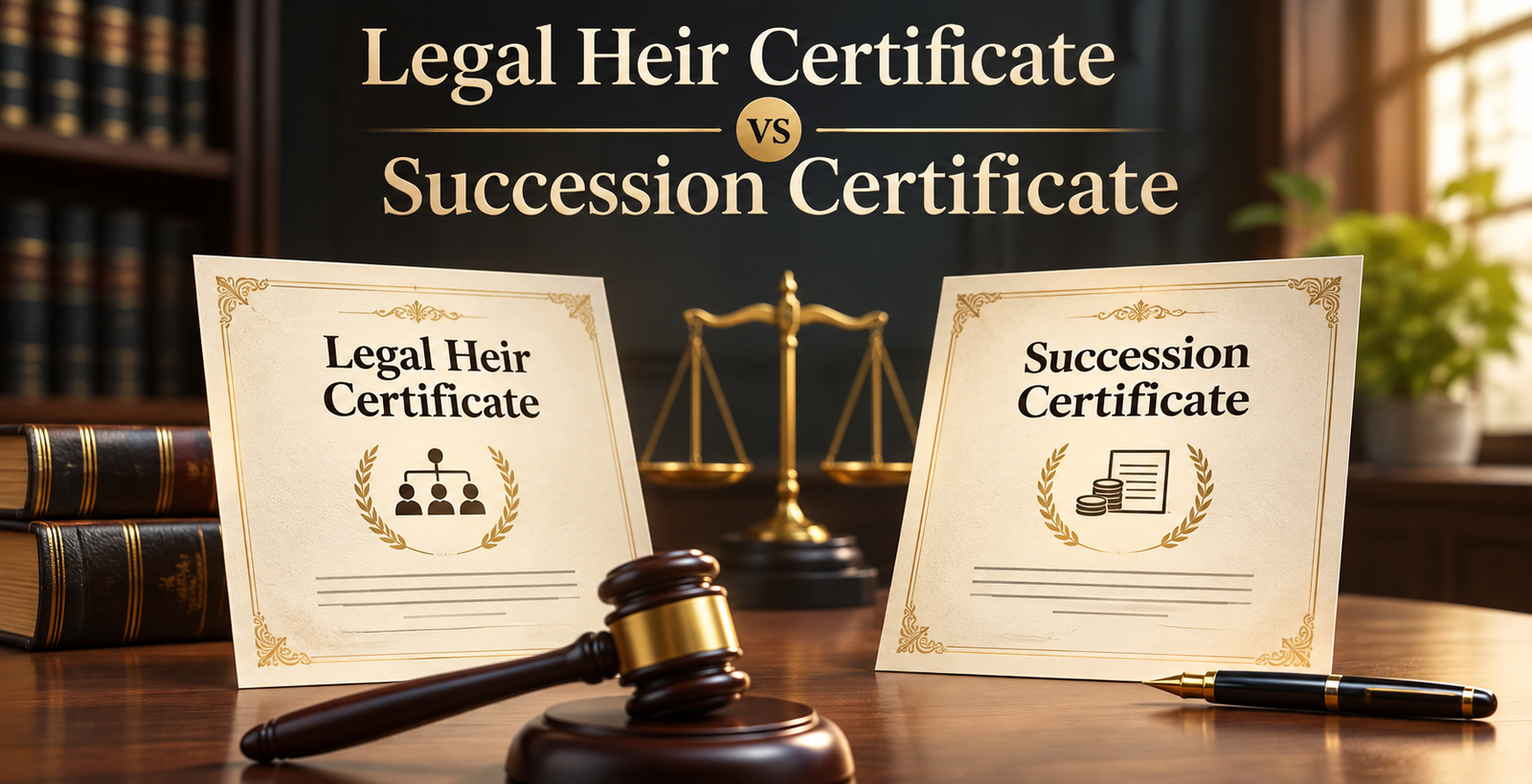
Legal Heir Certificate vs Succession Certificate: Key Differences
| Point | Legal Heir Certificate (Tehsildar) | Heirship Certificate (Civil Court) | Succession Certificate |
|---|---|---|---|
| Purpose | Identifies the legal heirs and their relationship | Court declaration of who the heirs are | Authority to collect debts and securities |
| Law | State revenue procedure | Bombay Regulation VIII of 1827 | Indian Succession Act, 1925 (Sections 370–390) |
| Issued by | Tehsildar (Revenue Department) | Civil court | Civil court (District Court) |
| Nature | Administrative document | Court order | Court order |
| Covers | Relationship proof only | Heirs to the estate, movable and immovable | Movable assets: bank money, shares, FDs, debts |
| Used for | Pension, utilities, mutation, small claims | Society transfer, property, bank claims, disputed families | Banks, companies, depositories, debtors |
| Public notice | Local inquiry by Talathi | Proclamation inviting objections | Notice and hearing before the court |
| Typical time | 15 to 30 days | 3 to 6 months | 3 to 6 months (longer if contested) |
| Cost | Nominal fee | Court fee plus legal fees | Court fee based on value plus legal fees |
Documents Required
For a legal heir certificate in Maharashtra (Tehsildar)
- Death certificate of the deceased
- Identity proof (Aadhaar or PAN) and address proof of the applicant
- Identity proof of all legal heirs
- Affidavit or self-declaration listing all heirs and their relationship to the deceased
- Proof of relationship, such as birth certificates, marriage certificate or ration card
- Proof of the deceased’s residence
For a succession certificate or court heirship certificate
- Death certificate of the deceased
- Petition with details of all legal heirs, their ages and addresses
- List of the debts and securities claimed, with account numbers, folio numbers and amounts (for a succession certificate)
- Proof of relationship of each heir with the deceased
- Proof that the deceased ordinarily resided within the court’s area
- No-objection affidavits or consent from the other heirs, where available
- Identity and address proof of the petitioner
- Court fee as per the Maharashtra Court-fees Act, 1959
Process: How to Get Each Certificate in Maharashtra
Legal heir certificate from the Tehsildar
- Register and log in on the Aaple Sarkar portal, or visit the Tehsildar or Setu office.
- Select the Revenue Department service for the legal heir certificate.
- Fill in the details of the deceased and all legal heirs.
- Upload the documents and pay the fee.
- The Talathi or Circle Officer conducts a local inquiry.
- The Tehsildar issues the certificate, which can be downloaded once approved.
Succession certificate from the civil court
- A lawyer drafts the petition under Section 372 of the Indian Succession Act with details of the deceased, the heirs and the debts and securities.
- The petition is filed before the competent civil court where the deceased ordinarily lived, with the court fee.
- The court issues notice to the other heirs and publishes a public notice inviting objections, usually allowing about 45 days.
- If there are no objections, the court records evidence and hears the matter.
- The court may ask the petitioner to furnish a security or indemnity bond (Section 375).
- The court passes an order, and the succession certificate is issued for the listed debts and securities.
The court process for a heirship certificate under the Bombay Regulation is similar: petition, proclamation inviting objections, evidence and order.
Time Taken and Cost
| Certificate | Usual time | Main cost |
|---|---|---|
| Legal heir certificate (Tehsildar) | 15 to 30 days after the inquiry | Nominal government fee |
| Heirship certificate (civil court) | 3 to 6 months if uncontested | Court fee as per the Maharashtra Court-fees Act, capped at ₹75,000 (₹10,000 for widows) plus legal fees |
| Succession certificate (civil court) | 3 to 6 months if uncontested; can take a year or more if contested | Court fee as a percentage of the value of the debts and securities, plus legal fees |
The time depends on the court’s workload, whether all heirs give consent and whether anyone files an objection. A complete petition with consent affidavits from all heirs is the single biggest factor in getting the certificate quickly.
Which Certificate Do You Need?
- Bank account, FDs or shares with no nominee: succession certificate (or the bank’s own claim process for smaller amounts)
- Family pension, gratuity, utility transfers: legal heir certificate from the Tehsildar
- Mutation of land or property in revenue records: legal heir certificate, or mutation based on the heirs’ statement before the Talathi
- Housing society flat transfer or sale of inherited property where heirs are not on the same page: court heirship certificate, plus release deeds or consent from the other heirs
- The deceased left a will: probate or letters of administration may be needed instead, not a succession certificate
Frequently Asked Questions
Is a succession certificate the same as a legal heir certificate?
No. A legal heir certificate only identifies the heirs and their relationship with the deceased. A succession certificate is a court order under the Indian Succession Act, 1925 that authorises a person to collect the deceased’s debts and securities, such as bank deposits and shares. You may need both: the legal heir certificate to prove relationship, and the succession certificate to release the money.
Can a legal heir sell property without a succession certificate?
Yes. A succession certificate does not cover immovable property, so it is not needed to sell a flat, house or land. What the heir needs is a clear title: the property must be mutated in the names of the heirs in the 7/12 extract, property card or society records, and all the other legal heirs must either join the sale or give up their share through a registered release deed. Buyers and banks often also ask for a heirship certificate or no-objection from the other heirs.
Is a succession certificate mandatory for property transfer in Maharashtra?
No. A succession certificate is for movable assets such as bank money and shares. For a flat, house or land in Maharashtra, the transfer is done through mutation in revenue or municipal records, transfer in the housing society’s records, and release or consent deeds from the other heirs. If the heirs disagree or a society or buyer insists on stronger proof, a court heirship certificate may be required.
What is the time limit for a succession certificate?
The Indian Succession Act does not set a deadline for applying. Some courts apply the three-year period under Article 137 of the Limitation Act, but the Bombay High Court has held that the right to apply for a succession certificate is a continuing right that can be exercised as long as the need exists. It is still best to apply early, because delay makes it harder to trace records and get consent from all heirs.
What is a legal heir certificate called in Maharashtra?
The certificate issued by the Tehsildar is often called a “Varas Dakhla” or legal heir certificate. The court-issued document under the Bombay Regulation VIII of 1827 is called a heirship certificate.
Can I apply for a legal heir certificate in Maharashtra online?
Yes. The Tehsildar’s legal heir certificate can be applied for online through the Aaple Sarkar portal. A succession certificate or heirship certificate has to be applied for by filing a petition in the civil court.
Need Help With a Legal Heir or Succession Certificate in Navi Mumbai?
Choosing the right certificate and filing a complete petition the first time can save your family months. At Advocate Pooja Agrawal & Associates in Seawood, Navi Mumbai, we help families with legal heir certificates, succession certificates, heirship certificates, property mutation and release deeds across Navi Mumbai, Thane and Mumbai. Contact Advocate Pooja today to discuss your case.
Disclaimer: This article is for general information only and is not legal advice. Court fees, timelines and procedures can change and may differ by court. Please consult a lawyer about your specific situation.