How to Recover Money in India
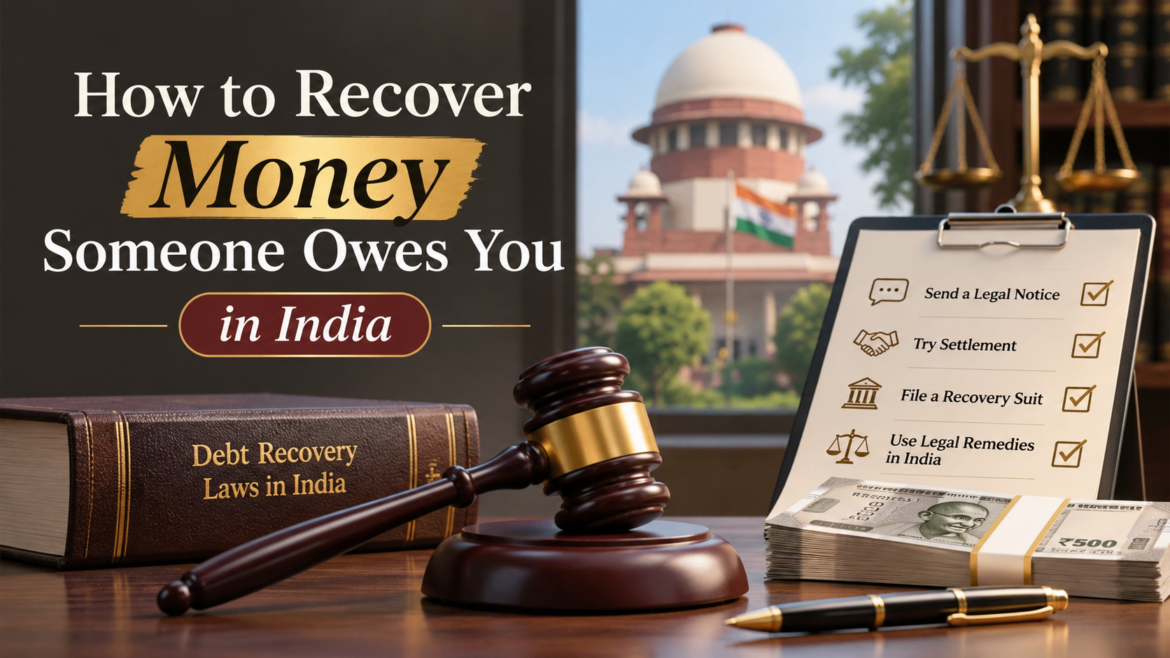
To recover money someone owes you in India, first collect proof of the payment, then send a legal notice for money recovery through a lawyer. If the person still does not pay, you can file a summary suit under Order XXXVII of the CPC (when you have a written document such as a loan agreement, promissory note or acknowledgement), a regular civil recovery suit, or a cheque bounce case under Section 138 of the Negotiable Instruments Act if their cheque was dishonoured. A criminal complaint for cheating is possible only when the person meant to deceive you from the start. You generally have 3 years to file a recovery case.
Lending money to a friend, relative, client or business partner is common. Getting it back is often the hard part. Calls go unanswered, promises keep changing and months turn into years. The good news is that Indian law gives you several clear ways to recover your money. This guide explains each option, when to use it and what proof you need.
What Can I Do If Someone Owes Me Money?
The right step depends on three things: how you gave the money, what proof you have, and whether the other person simply failed to pay or cheated you on purpose. Here is a quick overview of the money recovery laws in India and when each one applies.
| Option | When to Use It | Law |
|---|---|---|
| Legal notice | First step in almost every case | Contract Act; CPC; NI Act (for cheques) |
| Summary suit | Debt based on a written document or a dishonoured cheque | Order XXXVII, Civil Procedure Code, 1908 |
| Civil recovery suit | Debt without a written contract, or a complex dispute | Civil Procedure Code, 1908 |
| Cheque bounce case | The borrower gave a cheque that bounced | Section 138, Negotiable Instruments Act, 1881 |
| Criminal complaint | Fraud or cheating from the start, or misuse of entrusted money | Sections 318 and 316, Bharatiya Nyaya Sanhita, 2023 |
| Mediation / Lok Adalat | Both sides are willing to settle | Mediation Act, 2023; Legal Services Authorities Act, 1987 |
| Consumer complaint | You paid for goods or services that were not delivered | Consumer Protection Act, 2019 |
Step 1: Collect Proof of the Money You Gave
Every recovery case rests on evidence. Before you take any legal step, gather everything that shows you gave the money and that the other person agreed to return it:
- Bank and UPI records: NEFT, RTGS, IMPS or UPI transfer statements showing the amount and the date.
- Written documents: loan agreement, promissory note, receipt, invoice or any signed acknowledgement of the debt.
- Messages and emails: WhatsApp chats, SMS or emails where the person admits the loan or promises to repay.
- Cheques: any cheque given as repayment or security, along with the bank’s return memo if it bounced.
- Call recordings and witnesses: people who were present when the money was given or when repayment was promised.
A written acknowledgement or a part payment is especially useful. Under the Limitation Act, 1963, a signed acknowledgement of the debt, or a part payment, made within the limitation period starts a fresh 3-year period.
Step 2: Send a Legal Notice for Money Recovery
A debt recovery legal notice is a formal written demand sent by your lawyer to the person who owes you money. It states the amount due, how and when it was given, and a deadline (usually 15 to 30 days) to repay. It also warns that civil or criminal proceedings will follow if the payment is not made.
In many cases, a legal notice alone gets results. It shows you are serious and gives the other person a last chance to settle before the matter goes to court. It also becomes an important document in any later case.
What a legal notice for money recovery should include
- Your name and address, and the name and address of the person who owes you money
- The amount given, the date and the mode of payment (cash, bank transfer, UPI, cheque)
- The terms of repayment that were agreed, and the date the payment became due
- Interest claimed, if agreed or allowed by law
- A clear deadline to repay and the legal action you will take if they do not
Send the notice by registered post or speed post with acknowledgement due, and keep the postal receipts and tracking proof. A copy by email or WhatsApp is useful as extra proof of delivery. If the money relates to a bounced cheque, the notice must follow the strict timelines of Section 138 explained below.
Step 3: File a Summary Suit Under Order XXXVII CPC
If the legal notice does not work and you have written proof, a summary suit is usually the fastest civil route to recover money in India. It is filed under Order XXXVII of the Civil Procedure Code, 1908.
When can you file a summary suit?
A summary suit can be filed to recover a fixed sum of money (with or without interest) that is based on:
- A bill of exchange, hundi or promissory note
- A written contract or written acknowledgement of the debt
- A dishonoured cheque
- A guarantee, where the claim is only for a debt or a fixed sum
Why a summary suit is faster
In an ordinary suit, the defendant can defend the case as a matter of right. In a summary suit, the defendant must first enter appearance within 10 days of being served and then ask the court for leave to defend, usually within 10 days of receiving the summons for judgment. The court grants leave only if the defendant shows a real, substantial defence. If leave is refused, or the defendant does not apply, the court can pass a decree for the amount claimed without a full trial.
Because of this, a summary suit is often decided much faster than a regular recovery suit. Summary suits are filed in the courts and High Courts where this procedure applies, so the forum depends on the amount and where the cause of action arose.
Step 4: File a Regular Civil Recovery Suit
If you do not have a written agreement but have other proof, such as bank transfers and chats, you can file an ordinary civil suit for recovery of money. The court will decide the case after a full trial with evidence and witnesses. It takes longer than a summary suit, but it is the right route when the facts are disputed or the proof is not in a single written document.
For commercial disputes (for example, unpaid invoices between businesses) of ₹3 lakh or more, the Commercial Courts Act, 2015 generally requires pre-institution mediation before filing the suit, unless urgent interim relief is needed.
Step 5: Cheque Bounce Case Under Section 138 NI Act
If the person gave you a cheque to repay a legally enforceable debt and it bounced, you can file a criminal complaint under Section 138 of the Negotiable Instruments Act, 1881. This is one of the most effective recovery tools because the drawer faces a possible jail term of up to 2 years, a fine of up to twice the cheque amount, or both.
The timelines are strict and missing any of them can end your case:
| Step | Time Limit |
|---|---|
| Present the cheque to the bank | Within its validity (3 months from the cheque date) |
| Send a demand notice to the drawer | Within 30 days of receiving the bank’s return memo |
| Time given to the drawer to pay | 15 days from receiving the notice |
| File the complaint before the Magistrate | Within 1 month after the 15-day period ends |
The court can also order the accused to pay interim compensation of up to 20% of the cheque amount under Section 143A of the NI Act while the case is pending.
Can I File an FIR If Someone Is Not Returning My Money?
Only in some cases. Not paying back a loan is, by itself, a civil dispute, not a crime. You can approach the police only when there is a criminal element, for example:
- Cheating (Section 318, BNS): the person took your money by deceiving you and never intended to return it, such as fake investment schemes, false promises or forged documents. This section replaced Section 420 of the IPC.
- Criminal breach of trust (Section 316, BNS): money was entrusted to the person for a specific purpose and they dishonestly used it for themselves. This replaced Section 406 of the IPC.
The Supreme Court has repeatedly said that a simple failure to repay, or a breach of contract, does not amount to cheating unless dishonest intention existed at the start of the transaction. Filing a criminal case only to pressure someone into paying can be quashed by the High Court.
If the police refuse to register an FIR where an offence is made out, you can approach the Superintendent of Police, or file a complaint before the Magistrate, who can order an investigation under Section 175(3) of the Bharatiya Nagarik Suraksha Sanhita (BNSS), 2023.
Can Police Do Recovery of Money?
No. The police have no power to recover money for you or to act as a civil court. In Lalit Chaturvedi v. State of Uttar Pradesh (2024), the Supreme Court held that the police cannot act as recovery agents in a money dispute, and that non-payment of money is a civil wrong. The police can investigate a crime such as cheating, but getting your money back is done through a civil suit, a cheque bounce case, a settlement, or a court-approved compensation order.
How to Recover Money Given in Cash
Cash loans are harder to prove, but they are not impossible to recover. If you gave money in cash:
- Collect any written acknowledgement, receipt or diary entry signed by the borrower.
- Save WhatsApp messages, SMS or call recordings where the person admits taking the money or promises to pay it back.
- Identify witnesses who saw the money being handed over or heard the promise to repay.
- Show where the cash came from, such as a bank withdrawal around the same date.
- Ask for a written acknowledgement or a part payment through the bank. Either one strengthens your case and resets the limitation period.
Keep in mind that income tax law restricts taking or repaying loans of ₹20,000 or more in cash, and large unexplained cash transactions can raise tax questions for both sides. Speak to a lawyer before filing a case based on a large cash loan so the claim is framed correctly.
Other Options: Mediation, Lok Adalat and Consumer Court
- Mediation: a neutral mediator helps both sides agree on a repayment plan. A settlement agreement reached under the Mediation Act, 2023 is binding and enforceable.
- Lok Adalat: a free and quick way to settle money disputes. An award passed by a Lok Adalat is final and is treated as a decree of a civil court.
- Consumer court: if you paid a business or service provider for goods or services they never delivered, you can file a consumer complaint for a refund and compensation under the Consumer Protection Act, 2019.
- Insolvency proceedings: if a company owes you ₹1 crore or more, you may be able to start insolvency proceedings against it under the Insolvency and Bankruptcy Code, 2016.
Time Limit to Recover Money in India
Under the Limitation Act, 1963, a suit to recover money lent must generally be filed within 3 years. The period usually runs from the date the loan was given or, where a repayment date was fixed, from the date payment became due. A written acknowledgement or part payment made within this period gives you a fresh 3 years. Cheque bounce cases have much shorter deadlines, as shown above. Do not wait too long, because a time-barred claim cannot be recovered through court.
Common Mistakes to Avoid
- Lending large amounts without any written record or bank trail
- Missing the 30-day deadline to send the cheque bounce notice
- Filing an FIR for a pure civil dispute just to pressure the other person
- Using threats, harassment or force to recover money, which can lead to criminal cases against you
- Waiting more than 3 years before taking legal action
How Advocate Pooja Can Help You Recover Your Money
Adv. Pooja Agrawal & Associates in Navi Mumbai handles money recovery matters for individuals and businesses, including:
- Drafting and sending legal notices for money recovery
- Filing summary suits under Order XXXVII CPC and civil recovery suits
- Cheque bounce cases under Section 138 of the NI Act, for complainants and accused
- Criminal complaints for cheating and criminal breach of trust under the BNS
- Settlement through negotiation, mediation and Lok Adalat
Our team reviews your proof, chooses the fastest legal route for your situation, and handles the case from the first notice to the final recovery. Book a consultation with Advocate Pooja.
Frequently Asked Questions
- Can I file FIR if someone is not returning my money?
Only if there is a criminal element, such as cheating (Section 318, BNS) or criminal breach of trust (Section 316, BNS). If the person simply failed to repay a loan, it is a civil dispute, and the right remedy is a legal notice followed by a civil or summary suit.
- Can police do recovery of money?
No. The Supreme Court has held that the police have no power to recover money or act as a civil court. They can only investigate a criminal offence. Recovery happens through the courts or a settlement.
- How to deal with someone who owes you money?
Start by talking to them calmly and asking for a repayment date in writing. If that fails, send a legal notice through a lawyer, and then file a summary suit, a civil suit or a cheque bounce case depending on your proof. Never use threats or force.
- Can I file a complaint against someone who owes me money?
Yes. You can file a civil suit for recovery, a summary suit if you have written proof, or a criminal complaint under Section 138 of the NI Act if their cheque bounced. A police complaint for cheating is possible only if they deceived you from the beginning.
- How can I recover money from a person in India without a written agreement?
Bank or UPI transfer records, WhatsApp chats, emails, call recordings and witnesses can all prove a loan. Send a legal notice first, and then file a regular civil recovery suit based on this evidence.
- How much time do I have to recover money in India?
Generally 3 years under the Limitation Act, 1963, usually counted from the date the loan was given or fell due. A written acknowledgement or part payment within that period restarts the 3 years.
- How long does a legal notice for money recovery give the other person to pay?
Usually 15 to 30 days. For a cheque bounce notice under Section 138 of the NI Act, the law gives the drawer 15 days from receiving the notice.
- Is a summary suit faster than a normal recovery suit?
Yes. In a summary suit the defendant must get the court’s permission (leave to defend) to contest the case. If they cannot show a genuine defence, the court can pass a decree without a full trial.
Someone Owes You Money? Take the First Step Today
The longer you wait, the harder recovery becomes. Talk to the team at Adv. Pooja Agrawal & Associates in Navi Mumbai to understand the best way to recover your money, starting with a strong legal notice. Contact Advocate Pooja today.
Disclaimer: This article is for general information only and is not legal advice. Every case depends on its own facts, so please consult a lawyer before taking action.