How to File a Mental Harassment Complaint in India is a question many people ask when repeated threats, humiliation, pressure, or emotional abuse start affecting daily life. In India, there is no single standalone law called “mental harassment law” for every situation. The legal remedy depends on where the harassment happens, who is involved, and what form the conduct takes. In practice, a complaint may involve workplace rules, women-protection laws, or criminal provisions such as intimidation, insult, stalking, or cruelty, depending on the facts.
For readers of Advocate Pooja, this guide explains what mental harassment means, why legal action matters, the main legal routes in India, the steps to file a complaint, and the common problems people face during the process.
What is Mental Harassment?
What is Mental Harassment? In simple words, mental harassment means repeated behavior that causes emotional pain, fear, stress, humiliation, or mental trauma. It may happen at home, at work, online, or in public. It can include threats, abusive messages, constant insults, public humiliation, blackmail, stalking, intimidation, or deliberate pressure meant to break a person mentally.
Mental harassment does not always leave physical marks, but it can still be serious. In legal matters, the key issue is usually the nature of the conduct, the relationship between the parties, and the evidence available. That is why the same conduct may lead to different remedies in domestic, workplace, cyber, or criminal cases.
Call Now – 9920456025
Why Take Legal Action Against Mental Harassment?
Why Take Legal Action Against Mental Harassment? Because silence often makes the problem worse. Early legal action can help you:
- stop the harassment quickly
- create an official record of abuse
- protect your job, safety, and dignity
- preserve evidence before it disappears
- seek police help or formal workplace relief
- support later court action, if needed
For women facing harassment, official complaint systems also exist through the National Commission for Women (NCW), which accepts complaints involving harassment, domestic violence, cruelty, refusal to register FIR, and workplace sexual harassment.
Mental Harassment Laws in India
This is the most important part. Mental Harassment Laws in India are not found in one single section for every case. The law depends on the context.
1. Criminal law route
If the harassment includes threats, intimidation, stalking, defamation, or other criminal conduct, a police complaint may be possible under the Bharatiya Nyaya Sanhita, 2023 (BNS), which replaced the old IPC framework. The Bharatiya Nagarik Suraksha Sanhita, 2023 (BNSS) now governs criminal procedure in place of the old CrPC.
2. Domestic relationship route
If the harassment happens inside a domestic relationship and involves a woman, relief may be available under the Protection of Women from Domestic Violence Act, 2005. The NCW also lists domestic violence, cruelty by husband, and related harassment among the matters it processes through its complaint system.
3. Workplace route
If the issue happens at work, the remedy depends on the nature of the behavior:
- If the conduct is sexual harassment against a woman at workplace, the Sexual Harassment of Women at Workplace (Prevention, Prohibition and Redressal) Act, 2013 applies. Complaints can go to the employer’s Internal Committee (IC), and the SHe-Box portal is a government single-window platform for such workplace sexual harassment complaints.
- If the issue is general workplace bullying, humiliation, pressure, or verbal abuse that is not sexual in nature, the first route is usually internal HR, a written grievance, or the labour dispute system. The Ministry of Labour’s SAMADHAN portal supports industrial disputes, claims, and general complaints.
4. Women’s complaint route
Women facing harassment can also use the NCW Complaints Registration and Monitoring System, which allows online complaint registration and tracking.
Call Now – 9920456025
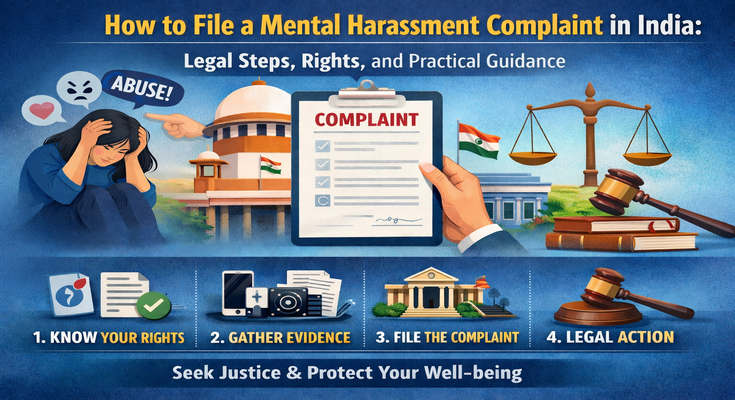
How to File a Mental Harassment Complaint in India
If you want to know How to File a Mental Harassment Complaint in India, follow these practical steps.
Step 1: Identify the type of harassment
Start by asking:
- Is it at home, office, school, online, or public?
- Is it domestic abuse, workplace harassment, sexual harassment, or criminal intimidation?
- Is the victim a woman, employee, spouse, student, or private citizen?
This step matters because the legal forum changes with the facts.
Step 2: Collect evidence
Gather proof before filing anything. Useful evidence includes:
- WhatsApp chats, emails, call logs, screenshots
- audio or video recordings, where legally available
- witness names and statements
- HR emails or written complaints
- medical records or therapy notes showing stress impact
- diary entries with dates, times, and incidents
Strong evidence often decides whether your complaint moves forward. The LawRato reference page also emphasizes collecting details and communication records before filing.
Step 3: File a written complaint
Prepare a short, clear complaint with:
- your name and contact details
- the harasser’s name and details
- dates, times, and places of incidents
- what exactly happened
- available evidence
- relief you want
Keep the tone factual. Do not exaggerate or add unverified claims.
Step 4: Choose the correct authority
This is where many people make mistakes.
- Police station: if there are threats, intimidation, stalking, or related criminal acts
- Employer / HR / Internal grievance cell: for non-sexual workplace mental harassment
- Internal Committee / SHe-Box: for workplace sexual harassment against a woman
- NCW complaint portal: for women facing harassment or deprivation of rights
- Labour route / SAMADHAN: for labour or employment-related grievance and dispute handling
Step 5: Keep proof of filing
Always keep:
- complaint copy
- diary number / acknowledgment
- email trail
- complaint reference number
- screenshots of online submission
Without proof of filing, follow-up becomes harder.
Step 6: Follow up and escalate if needed
If there is no action, send a reminder in writing. In serious matters, speak to a lawyer and consider the next legal forum. This is where a practical legal team like Advocate Pooja can help people choose the right route without wasting time on the wrong one.
Call Now – 9920456025
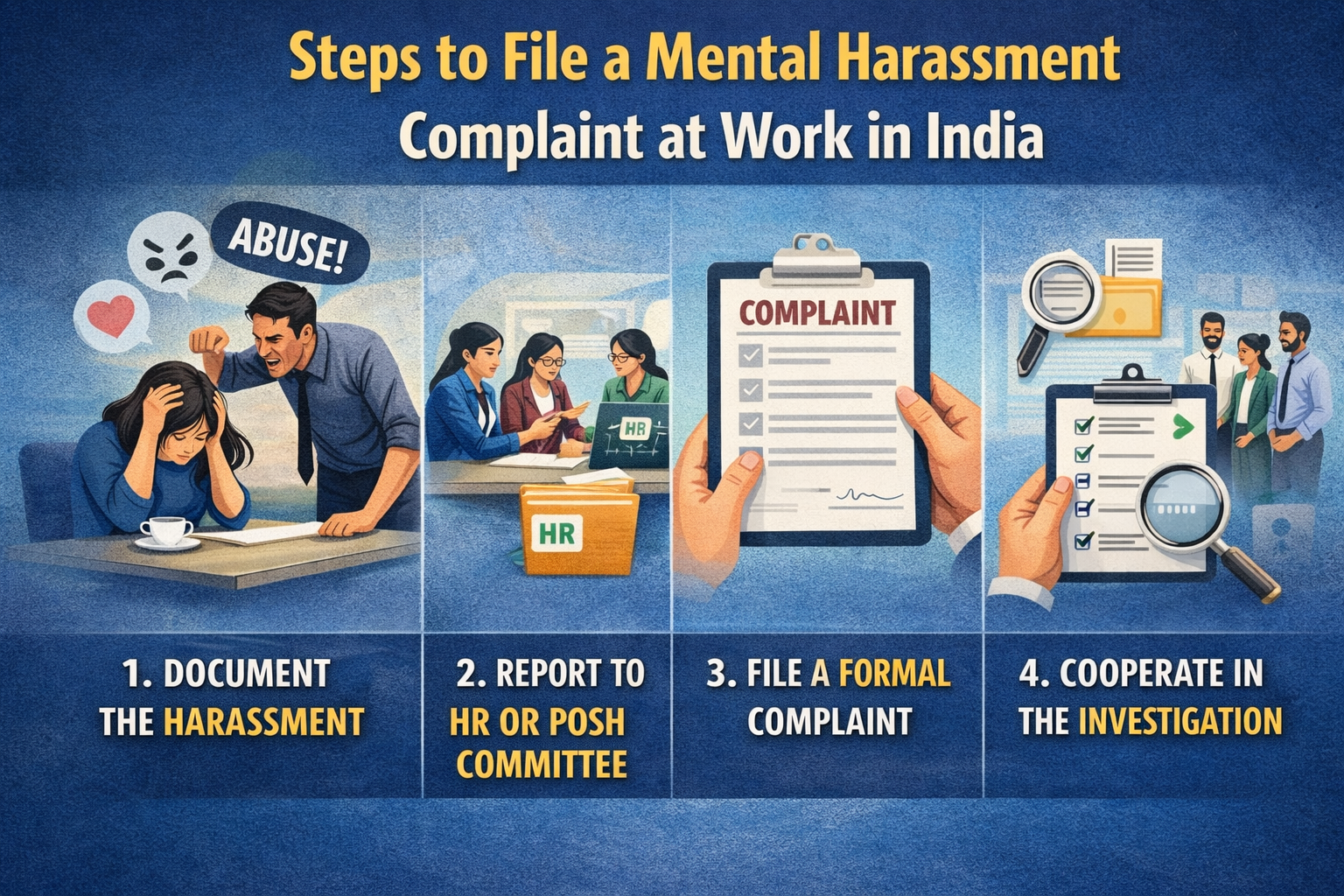
Steps to File a Mental Harassment Complaint at Work in India
This deserves its own section because search intent often focuses on office issues.
For general workplace mental harassment
If the conduct is not sexual in nature:
- Document each incident.
- Check your company policy or employee handbook.
- Send a written complaint to HR or the reporting authority.
- Ask for a written acknowledgment.
- Escalate to senior management if ignored.
- Use labour grievance channels if the dispute continues. SAMADHAN is an official labour platform for disputes, claims, and complaints.
For sexual harassment at workplace
If the harassment is sexual in nature and the complainant is a woman:
- File a complaint before the employer’s Internal Committee.
- Use the SHe-Box portal if needed.
- Track the complaint digitally on the government platform.
The SHe-Box portal specifically states that it is a single-window access system for women facing workplace sexual harassment, across organised or unorganised sectors, public or private.
Quick table: Where should you file the complaint?
| Situation | Best first step | Possible forum |
|---|---|---|
| Threats, intimidation, stalking, serious abuse | File police complaint | Police / criminal process under BNS-BNSS |
| General workplace mental harassment | Written complaint to HR | Employer grievance system / labour route / SAMADHAN |
| Sexual harassment at work against a woman | Complaint to Internal Committee | IC / SHe-Box portal |
| Harassment of women, domestic abuse, cruelty | Online complaint support | NCW complaint system |
Benefits and Importance of Filing a Complaint
Filing a complaint is important because it:
- creates a legal record
- forces the authority to notice the matter
- may stop repeat harassment
- strengthens future civil or criminal action
- helps protect mental peace and workplace dignity
- supports fair inquiry and accountability
A delayed complaint can still matter, but an early and well-documented complaint is usually stronger.
Tips and Best Practices
- Write facts in date order
- Save every message and email
- Use email instead of only verbal complaints
- Avoid angry or abusive replies
- Ask for acknowledgment every time
- Take legal advice before signing settlements
- Keep copies outside your office system too
Common Mistakes to Avoid
Challenges in Filing a Mental Harassment Complaint often arise because people make avoidable mistakes, such as:
- waiting too long to complain
- filing without evidence
- choosing the wrong forum
- mixing emotional language with weak facts
- deleting chats after reading them
- relying only on verbal witnesses
- not following up after filing
Another common challenge is that “mental harassment” may feel obvious to the victim but still needs to be matched with the correct legal category. That is why legal guidance matters.
Call Now – 9920456025
Conclusion
How to File a Mental Harassment Complaint in India depends on one simple rule: identify the correct legal route first. There is no one-size-fits-all complaint. A workplace issue may go to HR or labour authorities. A sexual harassment case at work may go to the Internal Committee or SHe-Box. A women’s rights issue may also be raised before the NCW. A serious threat or criminal act may require a police complaint under the current BNS-BNSS framework.
If you are facing repeated emotional abuse, threats, humiliation, or workplace pressure, do not ignore it. Document it, report it, and take legal advice early. Advocate Pooja can position this topic as a practical legal resource for people who want clear steps, not confusion.
Need help understanding where and how to file your complaint? Publish this guide on Advocate Pooja and encourage readers to seek timely legal advice through your website for workplace, family, and harassment-related matters.
FAQs
1. What is mental harassment in India?
Mental harassment means repeated conduct that causes emotional suffering, fear, humiliation, or mental stress. The legal remedy depends on the facts and the setting.
2. Can I file a police complaint for mental harassment?
Yes, if the facts involve criminal conduct such as threats, intimidation, stalking, or similar acts, a police complaint may be possible under the current criminal law framework.
3. How do I file a mental harassment complaint at work in India?
For general workplace harassment, start with HR or the employer grievance process. For workplace sexual harassment against a woman, use the Internal Committee or SHe-Box.
4. Can women file online complaints for harassment?
Yes. The NCW has an online complaint registration and monitoring system for harassment and related women’s rights complaints.
5. What is the biggest challenge in filing a mental harassment complaint?
The biggest challenge is usually proving the conduct and choosing the correct legal forum. Good evidence and timely filing improve the chances of action.