An “attempt to murder” charge is one of the most serious situations a person can face in Indian criminal law. It leads to immediate arrest, a difficult bail process, and a trial before the Sessions Court. The confusion is greater now that India’s criminal laws changed in 2024, moving from the Indian Penal Code to the Bharatiya Nyaya Sanhita.
This guide explains Section 109 BNS clearly and accurately — what it means, its punishment, whether it is bailable, its ingredients, and how it maps to the old IPC. It is written for general understanding; for any real case, speak to a qualified advocate.
What is Section 109 BNS?
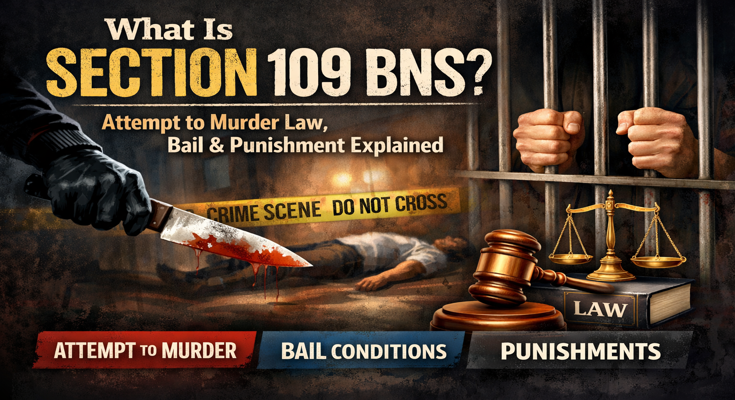
Section 109 BNS defines and punishes the offence of attempt to murder under the Bharatiya Nyaya Sanhita, 2023. It applies when a person acts with the intention or knowledge that their act could cause death, but death does not actually result. The offence is cognizable, non-bailable, and non-compoundable, and is tried by a Court of Session. It replaces Section 307 of the old IPC. Punishment ranges from up to 10 years imprisonment to life imprisonment, depending on the facts.
Understanding Section 109 BNS
The Bharatiya Nyaya Sanhita (BNS), 2023 came into force on 1 July 2024, replacing the Indian Penal Code, 1860. Section 109 falls within the chapter dealing with offences affecting the human body.
In simple terms, Section 109 BNS punishes a person who tries to kill another but fails. The crucial point is that death does not need to occur for the offence to apply. What matters is the intention or knowledge behind the act and the act itself. A person can be convicted of attempt to murder even if the victim escapes with minor injuries — or no injury at all.
This reflects a basic principle of criminal law: the law punishes the intention to kill combined with a real step towards it, not merely the outcome.
Section 109 BNS in IPC: the Section 307 connection
Many people still search using the old law, asking about “section 109 BNS in IPC” or the IPC equivalent. The answer is clear.
Section 109 BNS corresponds to Section 307 of the Indian Penal Code, 1860. Both deal with attempt to murder, and the essential definition and ingredients are carried forward almost unchanged. The main update in the BNS is a clarification, in Section 109(2), that “imprisonment for life” for certain repeat offenders means imprisonment for the remainder of that person’s natural life.
| Aspect | Old law | New law |
|---|---|---|
| Offence | Attempt to murder | Attempt to murder |
| Section | IPC Section 307 | Section 109 BNS |
| Statute | Indian Penal Code, 1860 | Bharatiya Nyaya Sanhita, 2023 |
| In force | Until 30 June 2024 | From 1 July 2024 |
| Key change | — | Natural-life imprisonment clarified for life convicts |
So if you read an older FIR, notice, or judgment mentioning “IPC 307,” the equivalent provision today is Section 109 BNS.
Section 109 BNS bare act: what the provision says
Understanding the structure of the Section 109 BNS bare act helps make sense of the punishment. The provision has two parts.
Section 109(1): Whoever does any act with such intention or knowledge, and under such circumstances that, if they caused death by that act they would be guilty of murder, commits attempt to murder. Such a person may be punished with imprisonment of up to ten years and a fine. If the act causes hurt to any person, the offender may instead be punished with imprisonment for life, or with the imprisonment and fine already mentioned.
Section 109(2): When a person already serving a sentence of imprisonment for life attempts to commit murder and, by that act, causes hurt, the punishment may extend to death, or imprisonment for life, which shall mean the remainder of that person’s natural life.
In short, the punishment rises with the seriousness of the situation — from imprisonment, to life imprisonment where hurt is caused, to the most severe penalties for a life convict who causes hurt during an attempt.
Core ingredients of Section 109 BNS
For a conviction, the prosecution must establish certain ingredients of Section 109 BNS. These are the building blocks of the offence.
- Intention or knowledge to cause death. The accused must have acted with the intention of causing death, or with knowledge that the act was likely to cause death — the same mental state required for murder.
- An act done towards it. There must be an actual act (the actus reus) taken in furtherance of that intention. A mere thought or plan is not enough; the person must do something.
- Circumstances amounting to murder if death had occurred. The act must be such that, had death resulted, it would legally amount to murder.
- Death did not occur. The offence is an attempt, so the intended death does not actually happen.
If any essential ingredient is missing — for instance, if there was no intention to kill — the charge may not stand, or may be reduced to a lesser offence. This is often the central battle in an attempt-to-murder trial.
Section 109 BNS punishment
The Section 109 BNS punishment is tiered according to the facts:
- Attempt with no hurt caused: imprisonment of up to 10 years, and a fine.
- Attempt where hurt is caused: imprisonment for life, or the imprisonment (up to 10 years) and fine.
- Attempt by a life convict, causing hurt: death, or imprisonment for life meaning the remainder of natural life.
The court decides the actual sentence based on the intention, the weapon used, the nature of the injuries, and the overall circumstances.
Section 109 BNS: bailable or not, cognizable, and triable
This is one of the most important practical questions. Here is how the offence is classified.
| Classification | Status |
|---|---|
| Cognizable or non-cognizable | Cognizable |
| Bailable or non-bailable | Non-bailable |
| Compoundable or not | Non-compoundable |
| Triable by | Court of Session |
Two points follow from this.
Section 109 BNS is bailable or not: It is non-bailable. This does not mean bail is impossible — it means bail is not a matter of right. Instead, it is at the discretion of the court (usually the Sessions Court, or the High Court), which examines the facts before deciding.
Cognizable: Because the offence is cognizable, the police can register an FIR, investigate, and arrest without a warrant or prior approval of a Magistrate. This is why arrests in such cases are often immediate.
What to Do When Police Refuse to Register Your FIR
Why intent matters more than the injury
A common misunderstanding is that attempt to murder requires serious injury. That is not correct. Indian courts have consistently held that the severity of the injury is not decisive. A person can be convicted even if the victim suffers no injury, provided the intention to kill and an act towards it are proved. Equally, the mere survival of the victim does not absolve the accused.
What the court focuses on is the intention or knowledge behind the act — the weapon used, the part of the body targeted, the force applied, and the surrounding circumstances all help establish that intent.
How bail works in a Section 109 BNS case
Because the offence is non-bailable and serious, bail is decided carefully. An accused usually applies to the Sessions Court, and may approach the High Court if needed. Anticipatory bail may be sought where arrest is apprehended.
Courts generally weigh factors such as the nature and gravity of the allegation, the weapon and injuries involved, the strength of the evidence, the role of the accused, the risk of the accused fleeing or influencing witnesses, and the accused’s background. Because so much depends on the specific facts, skilled legal representation makes a real difference at the bail stage.
A note on Section 110 BNS
It helps to know that BNS also contains Section 110, which deals with attempt to commit culpable homicide (not amounting to murder) — a related but distinct and generally less serious offence. Which section applies depends on the intention and circumstances, which is another reason accurate legal analysis of the facts matters.
A simple example
If a person fires a gun at someone intending to kill them, but the victim survives because of timely medical treatment, Section 109 BNS can apply — even though death did not occur. The intention to kill, combined with the act of firing, is what brings the case within the section.
What to do if you are involved in such a case
- Do not delay legal advice. Because the offence is cognizable and non-bailable, arrest can be immediate, and early legal help matters.
- Preserve and organise evidence. Since intention is central, the sequence of events, weapon, injuries, and witnesses are all important.
- Understand the bail process. Bail here is discretionary and usually decided by the Sessions Court, so preparation is key.
If you are dealing with a Section 109 BNS matter in Mumbai or Navi Mumbai, the criminal law team at Adv. Pooja Agrawal & Associates can explain your options based on the specific facts.
Frequently Asked Questions
What is Section 109 BNS?
Section 109 BNS deals with attempt to murder under the Bharatiya Nyaya Sanhita, 2023. It applies when a person acts with the intention or knowledge that their act could cause death, but death does not actually occur. It replaced Section 307 of the IPC.
Is Section 109 BNS bailable or not?
Section 109 BNS is non-bailable. This means bail is not a matter of right but is granted at the discretion of the court — usually the Sessions Court or High Court — after examining the facts and circumstances of the case.
What is Section 109 BNS in IPC?
Section 109 BNS corresponds to Section 307 of the Indian Penal Code, 1860. Both cover attempt to murder. The BNS replaced the IPC on 1 July 2024, carrying the offence forward with clarified punishment for repeat offenders.
What is the punishment under Section 109 BNS?
Punishment is up to 10 years’ imprisonment and a fine where no hurt is caused, life imprisonment where hurt is caused, and — for a life convict who causes hurt during an attempt — death or imprisonment for the remainder of natural life.
What are the ingredients of Section 109 BNS?
The main ingredients are: intention or knowledge to cause death, an act done towards it, circumstances that would amount to murder if death had occurred, and the fact that death did not actually result.
Is Section 109 BNS cognizable?
Yes. Section 109 BNS is a cognizable offence, so the police can register an FIR, investigate, and arrest without a warrant or prior Magistrate’s order.
Does attempt to murder require serious injury?
No. Courts have held that the severity of injury is not decisive. A person can be convicted even where the victim suffers little or no injury, as long as the intention to kill and an act towards it are proved.
Conclusion
Section 109 BNS carries forward the offence of attempt to murder from IPC Section 307. It is a serious, cognizable, and non-bailable offence, tried by the Court of Session, with punishment ranging from imprisonment up to 10 years to life imprisonment depending on the facts. Because so much turns on intention and the specific circumstances, timely and accurate legal advice is essential in any real case.
Disclaimer: This article is for general informational purposes only and does not constitute legal advice. Laws and their interpretation may change, and every case depends on its own facts. For advice on a specific matter, please consult a qualified advocate. Reading this article does not create a lawyer-client relationship.
Written by: The Legal Team at Adv. Pooja Agrawal & Associates
Reviewed by: Adv. Pooja Agrawal Gupta