Introduction
Can every criminal case in India be settled between the two parties? The short answer is — no. And that is exactly where the concept of compoundable and non-compoundable offences becomes important. If you or someone you know is involved in a criminal matter, one of the first things you need to understand is whether the offence can be resolved through mutual agreement or whether it must go through a full trial in court.
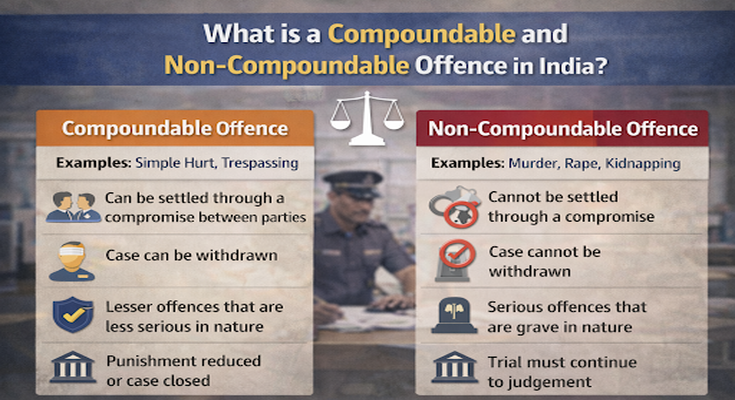
In simple terms, a compoundable offence allows the victim and the accused to reach a compromise and close the case. A non-compoundable offence, on the other hand, is too serious to be settled privately — the law requires a complete trial, and the state itself steps in as a party.
In this guide, Advocate Pooja explains everything you need to know about these two categories — what they mean, how they differ, what the law says, and what steps to take if you are facing either situation.
Call Now – 9920456025
What is a Compoundable Offence?
A compoundable offence is one where the victim (complainant) can choose to enter into a compromise with the accused and get the charges dropped. The law allows this because the offence is relatively minor and affects mostly the private individual rather than society as a whole.
This concept is governed by Section 320 of the Code of Criminal Procedure (CrPC), and its equivalent provisions now exist under the Bharatiya Nagarik Suraksha Sanhita (BNSS), 2023, which replaced the CrPC.
Compoundable offences fall into two sub-categories:
1. Without Court Permission
These can be settled directly between the victim and the accused, without needing the court’s nod.
Examples include:
- Voluntarily causing hurt (Section 323, IPC)
- Defamation (Section 500, IPC)
- Criminal trespass (Section 447, IPC)
- Criminal intimidation (Section 506, IPC — when imprisonment is up to 2 years)
- Insult intended to provoke a breach of peace (Section 504, IPC)
2. With Court Permission
These are slightly more serious and require the court to approve the compromise before the charges can be dropped.
Examples include:
- Voluntarily causing grievous hurt (Section 325, IPC)
- Theft (Section 379, IPC)
- Criminal breach of trust (Section 406, IPC)
- Dishonest misappropriation of property (Section 403, IPC)
- Assault on a woman with intent to outrage her modesty (Section 354, IPC)
Once a compoundable offence is settled, it has the same legal effect as an acquittal. The accused is treated as not guilty, and the matter is closed.
Call Now – 9920456025
What is a Non-Compoundable Offence?
A non-compoundable offence is one where no compromise is allowed between the parties, no matter what. Even if the victim is willing to forgive the accused, the case must go through the full legal process — investigation, trial, and judgment.
These offences are serious in nature. They do not just affect the individual victim — they harm society as a whole. That is why the State (government/police) files the case, not the private complainant. Since the state is the complainant, the victim alone cannot decide to withdraw the charges.
All offences that are not listed under Section 320 of CrPC are automatically classified as non-compoundable.
Examples of non-compoundable offences include:
- Murder (IPC Section 302)
- Rape (IPC Section 376)
- Dacoity and robbery
- Attempt to commit murder (IPC Section 307)
- Rash driving on a public road (IPC Section 279)
- Causing hurt by dangerous weapons (IPC Section 324)
- Criminal breach of trust by a public servant (IPC Section 409)
- Counterfeiting currency or government documents
In these cases, a full trial must take place, ending in either the acquittal or conviction of the accused based on evidence.
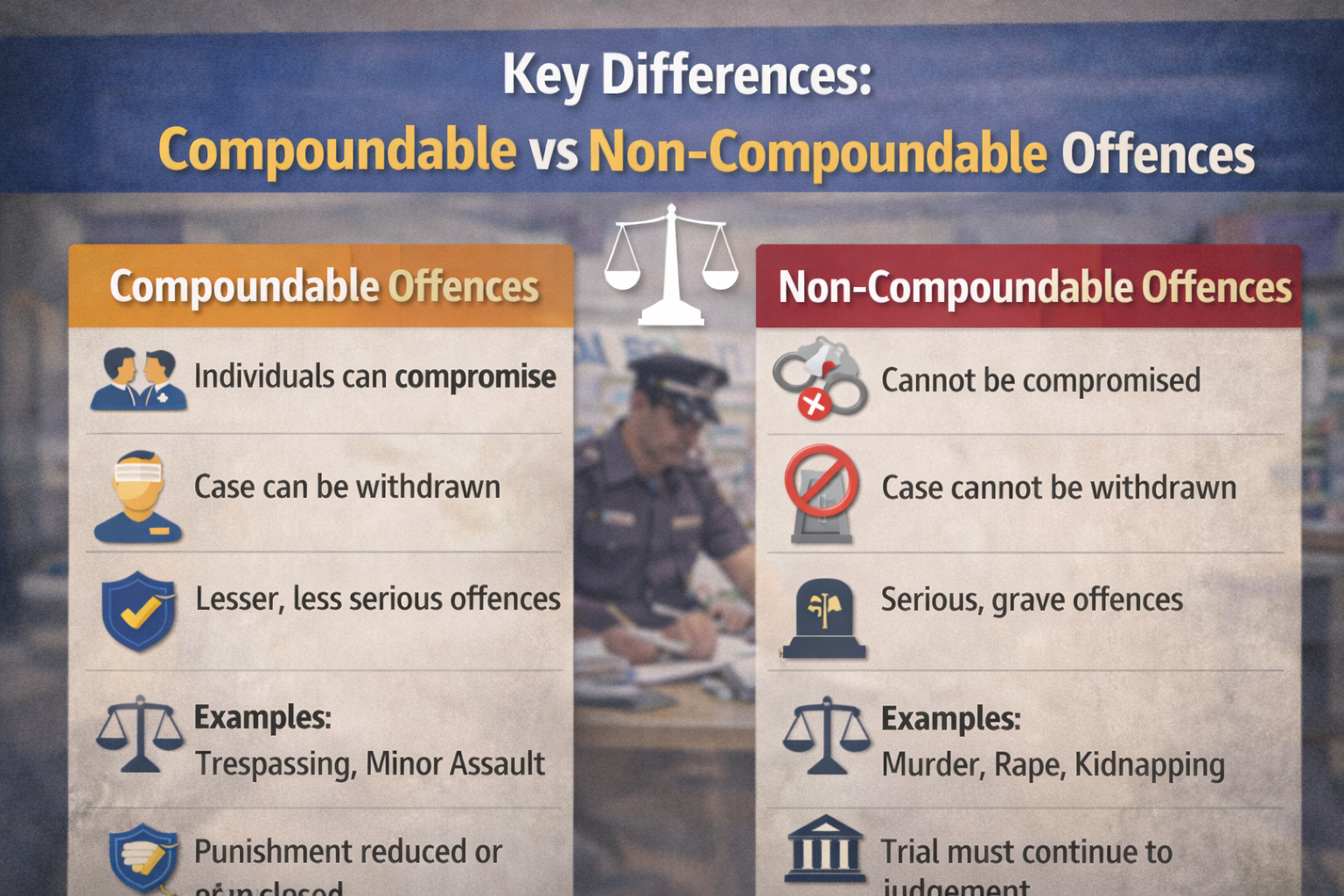
Key Differences: Compoundable vs Non-Compoundable Offences
| Factor | Compoundable Offence | Non-Compoundable Offence |
|---|---|---|
| Can be settled? | Yes, between victim and accused | No, must go to full trial |
| Court permission needed? | Sometimes (depends on category) | Not applicable — cannot be compounded |
| Who files the case? | Private individual (victim) | The State (police) |
| Nature of crime | Minor, affects individual | Serious, affects society |
| Effect of compromise | Equivalent to acquittal | Compromise has no legal effect |
| Governed by | Section 320, CrPC / BNSS | All offences outside Section 320 |
| Examples | Defamation, simple hurt, trespass | Murder, rape, dacoity, rash driving |
| Can High Court intervene? | Not usually needed | Yes, under Section 482 CrPC in rare cases |
Call Now – 9920456025
Can a Non-Compoundable Offence Ever Be Resolved?
This is one of the most common questions Advocate Pooja gets from her clients. The answer is nuanced.
A non-compoundable offence cannot be compounded — but in very exceptional circumstances, a High Court can quash the criminal proceedings using its inherent powers under Section 482 of CrPC (or equivalent powers under the BNSS).
The Supreme Court, in landmark judgments like B.S. Joshi v. State of Haryana and Gian Singh v. State of Punjab, ruled that High Courts can intervene to quash proceedings in non-compoundable cases — but only when:
- The offence is predominantly private in nature (like matrimonial disputes)
- Both parties have genuinely resolved the matter
- Continuing the trial would serve no public purpose
- The offence is not heinous or dangerous to society
The Supreme Court in The State of Madhya Pradesh v. Lakshmi Narayan laid down clear guidelines:
- The case must be predominantly civil or commercial in nature
- Heinous crimes like rape or murder cannot be quashed this way
- Offences committed by public servants in their official capacity cannot be quashed
- The conduct of the accused must be considered in private matters
- The court must examine evidence carefully before deciding
So, while quashing is possible in rare cases, it is not the same as compounding. It requires High Court involvement and happens only under strict conditions.
Step-by-Step: How to Compound a Compoundable Offence
If you are involved in a compoundable offence and both parties want to settle, here is the general process:
- Assess the type of offence. Determine whether the offence falls under Section 320 CrPC / BNSS and whether court permission is needed.
- Reach a genuine mutual agreement. Both sides must agree voluntarily — no pressure or illegal consideration.
- File a joint application before the trial court. The application must be made in the same court where the trial is ongoing.
- Attend the court hearing. If court permission is required, both parties must appear and confirm the compromise.
- Get the court’s order. Once accepted, the court passes an order of acquittal in favour of the accused.
- Ensure proper documentation. Keep a record of the settlement and court order for future reference.
Why This Classification Matters
Understanding whether an offence is compoundable or non-compoundable is not just academic knowledge — it has real, practical consequences.
- It determines whether you can avoid a lengthy trial by settling the matter
- It tells you whether the State can override your decision as a victim
- It affects the accused’s chances of avoiding conviction
- It shapes your legal strategy — should you fight in court or try to settle?
As Advocate Pooja often explains to clients: “Knowing the nature of the offence against you is the first step toward taking the right legal action. A wrong assumption here can cost you time, money, and the outcome of your case.”
Call Now – 9920456025
Compounding Under Other Laws
Compoundable offences are not just a concept under criminal law. Other statutes also allow compounding:
- FEMA (Foreign Exchange Management Act), 1999: The RBI can compound violations under Section 13 of FEMA. This helps businesses avoid litigation and reduce the judicial burden.
- Income Tax Act: The Chief Commissioner of Income Tax can compound tax offences under Section 279(2) — but this is not an absolute right.
- Companies Act, 2013: Under Section 441, offences punishable only with a fine can be compounded. Offences punishable with imprisonment cannot.
Common Mistakes People Make
Dealing with a criminal case — whether as a victim or an accused — is stressful. Many people make avoidable mistakes because they do not understand the law clearly.
Mistake 1: Assuming any offence can be settled privately. Not all cases can be resolved between parties. Non-compoundable offences must go through the full legal process, regardless of what both sides agree to.
Mistake 2: Trying to compound an offence after conviction without court approval. If the accused has already been convicted and an appeal is pending, you still need court permission to compound — even for compoundable offences.
Mistake 3: Thinking a private settlement stops a non-compoundable case. Even if the victim signs an affidavit saying they forgive the accused, the State will continue the prosecution in non-compoundable cases. The case does not automatically close.
Mistake 4: Not consulting a lawyer before filing a compromise application. A poorly drafted application or incorrect procedure can result in the court rejecting the settlement. Always take legal help.
Mistake 5: Confusing “quashing” with “compounding.” These are two different legal remedies. Compounding is done in the trial court. Quashing is done by the High Court under its inherent powers and only in exceptional cases.
Best Practices When Dealing With Compoundable Offences
- Always get the terms of the settlement in writing
- Make sure no money or favour is exchanged illegally as part of the compromise
- File the compounding application as early as possible — ideally before the trial begins
- Attend all court hearings personally when required
- Keep copies of all documents — the FIR, complaint, settlement deed, and court order
Frequently Asked Questions
1. What is the difference between a compoundable and a non-compoundable offence in India?
A compoundable offence allows the victim and accused to settle the matter through compromise, and the charges are dropped. A non-compoundable offence is too serious to be settled privately — it must go through a complete court trial. The state files the case and does not allow private compromise.
2. Can a non-compoundable offence be settled out of court in India?
Generally, no. Non-compoundable offences cannot be settled by the parties. However, in exceptional cases involving private or matrimonial disputes, a High Court can quash the proceedings under Section 482 of CrPC. This is different from compounding and requires judicial discretion.
3. What happens after a compoundable offence is settled?
Once the court accepts the compromise, it passes an order that has the same effect as an acquittal. The accused is legally treated as not guilty. The case is closed and cannot be reopened on the same facts.
4. Does the victim’s consent always stop a criminal case in India?
Only in compoundable offences. If the offence is non-compoundable, the state controls the prosecution. Even if the victim does not want to proceed, the police and court can continue the case independently.
5. Do I need a lawyer to compound a criminal offence?
While it is not legally mandatory, it is strongly advisable. The procedure involves filing proper applications, attending court hearings, and ensuring the settlement is legally valid. A criminal lawyer like Advocate Pooja can guide you through the entire process and help you avoid costly mistakes.
Conclusion
The distinction between compoundable and non-compoundable offences in India is a cornerstone of the criminal justice system. It determines whether a case can be resolved through mutual agreement or must be decided by the court after a full trial.
For compoundable offences, the law offers both sides a chance to settle — sparing them from the time, cost, and uncertainty of lengthy litigation. For non-compoundable offences, the law takes a firm stand: serious crimes that affect society cannot be swept under the rug, no matter what the parties agree to.
Whether you are a victim or an accused, understanding this distinction early can help you make smarter legal decisions and protect your rights effectively.
Speak to Advocate Pooja — Get the Right Legal Advice Today
Criminal cases are stressful. But with the right legal guidance, you do not have to face them alone. Advocate Pooja has extensive experience in criminal law and helps clients across India understand their rights, navigate complex procedures, and achieve the best possible outcomes.
Whether your matter involves a compoundable offence you want to settle, or a serious charge you need to defend — Advocate Pooja is here to help.