
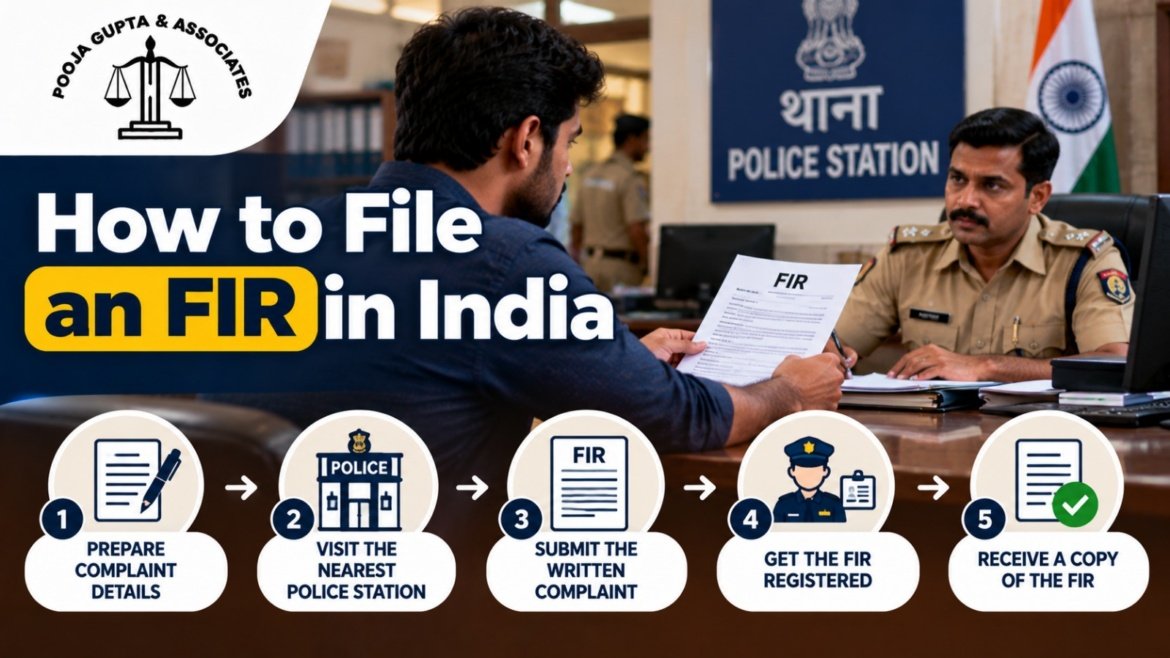
To file an FIR (First Information Report) in India, you can either visit any police station in person or file an online FIR (e-FIR) through your state’s police portal, under Section 173 of the Bharatiya Nagarik Suraksha Sanhita (BNSS), 2023 — which replaced Section 154 of the CrPC from 1 July 2024. Filing an FIR is completely free of cost, and you’re legally entitled to a free copy immediately. You can file at any police station regardless of jurisdiction (called a Zero FIR) for cognizable offences, and there is no requirement that an FIR must be filed within 24 hours of an incident — that 24-hour rule actually applies to producing an arrested person before a magistrate, not to reporting a crime.
What Is an FIR?
An FIR, or First Information Report, is the document police prepare when they receive information about the commission of a cognizable offence — a crime serious enough that police can arrest without a warrant and begin investigating without needing a magistrate’s prior permission (examples include theft, assault, and cheating). For non-cognizable offences (less serious matters), the police cannot register a regular FIR directly; these require a magistrate’s order under Section 174 BNSS instead.
The landmark Supreme Court judgment in Lalita Kumari v. Government of Uttar Pradesh, (2014) 2 SCC 1, decided by a 5-judge Constitution Bench, established that police must register an FIR when information discloses a cognizable offence — they cannot refuse to do so or conduct an informal “preliminary enquiry” first, except in a narrow set of circumstances (such as matrimonial disputes or commercial matters) where a limited preliminary check is now permitted under BNSS.
Current Legal Framework: BNSS Has Replaced CrPC
Since 1 July 2024, FIR registration in India is governed by Section 173 of the BNSS, not the earlier Section 154 of the CrPC. If you’ve read older articles or watched older legal videos referencing “Section 154,” that provision has been replaced — Section 173 BNSS introduced three significant changes:
- Electronic information is now expressly recognised — you can give information about a crime electronically, not just in person
- Zero FIR now has statutory backing — previously a judicially-evolved practice, it’s now written directly into law
- A free copy of the FIR must be given to the informant immediately — this is now an explicit statutory right under Section 173(2)
Types of FIR at a Police Station
Understanding the different types of FIR helps you know which applies to your situation:
| Type | What It Means |
|---|---|
| Regular FIR | Filed at the police station with jurisdiction over the area where the offence occurred |
| Zero FIR | Filed at any police station regardless of where the crime happened; registered with serial number “0” and then transferred to the correct jurisdiction |
| e-FIR | Filed electronically through a state police portal; must be signed in person within 3 days to be formally recorded |
How to File an FIR Offline (At a Police Station)
- Go to the nearest police station — for a Zero FIR, this can be any station, regardless of where the offence took place
- Provide your information — you can give it orally or in writing; if given orally, the officer must write it down and read it back to you for verification
- Verify and sign — check the written FIR matches what you reported before signing
- Collect your free copy — under Section 173(2) BNSS, you’re entitled to a copy of the FIR immediately and at no cost
- Note the FIR number — you’ll need this to track the status of your case going forward
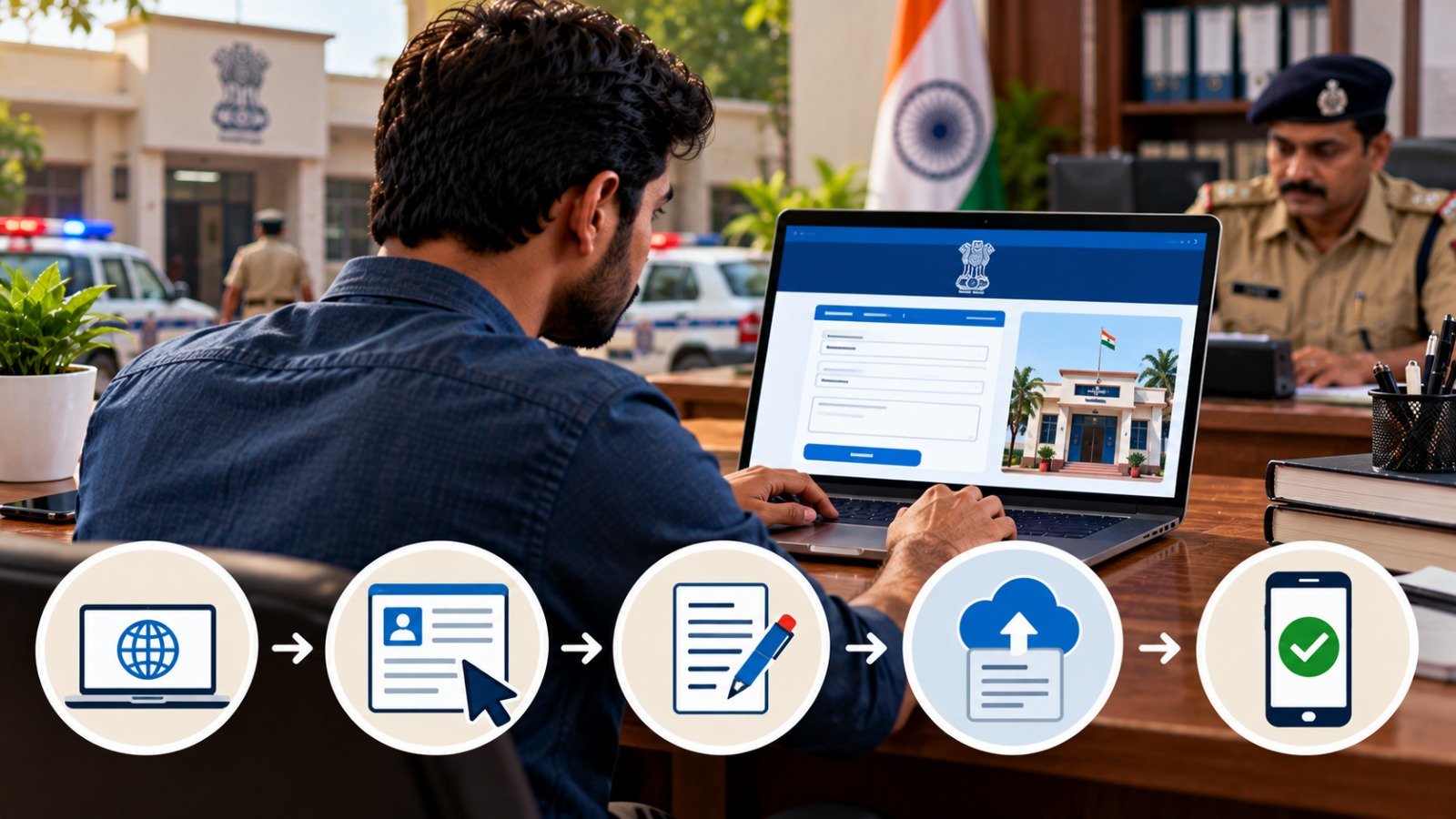
How to File an FIR Online in India (e-FIR)
Can I file an FIR online in India? Yes. Section 173(1) BNSS explicitly permits giving information “by electronic communication.” Here’s how:
- Visit your state police department’s official e-FIR portal (most states now have one, accessible via the CCTNS — Crime and Criminal Tracking Network and Systems — framework)
- Fill in your personal details and a clear description of the incident, along with any supporting documents or evidence you have
- Submit the complaint electronically
- Visit the police station within 3 days to sign the complaint — this step is mandatory; an e-FIR is only formally recorded once you’ve signed it in person, which prevents anonymous or fake complaints while still allowing convenient digital reporting
- The complaint is then forwarded to an investigating officer for verification and further action
Does Filing an FIR Cost Money?
No. Filing an FIR is completely free, whether done in person or online. You are also legally entitled to receive a copy of the FIR free of cost, immediately after it’s registered, under Section 173(2) BNSS. If any police official asks for payment to register or provide a copy of an FIR, this is not a legitimate requirement.
The “24 Hours” Myth About Filing an FIR
Many people mistakenly believe an FIR should be filed within 24 hours of an incident, or worry they’ve lost their right to report a crime if more time has passed. This is a common misconception. There is no legal deadline requiring an FIR to be filed within 24 hours of a crime occurring — you can file an FIR after 24 hours, after several days, or even longer, though reporting promptly is generally advisable since it helps preserve evidence and strengthens your case.
The actual 24-hour rule in Indian criminal law applies to something different: under Section 58 of the BNSS (and Article 22(2) of the Constitution), a person who has been arrested must be produced before a magistrate within 24 hours of arrest, excluding travel time. This is a safeguard against unlawful detention — it has nothing to do with when a victim or complainant must report a crime.
What Happens If the Police Refuse to File an FIR?
Following the Lalita Kumari precedent, police are legally required to register an FIR for a cognizable offence. If they refuse:
- Escalate to the Superintendent of Police (SP) in writing, under Section 173(4) BNSS, describing the substance of your complaint
- If the SP is satisfied that a cognizable offence is disclosed, they can either investigate the matter personally or direct a subordinate officer to register the FIR
- As a further step, you can approach the jurisdictional Magistrate under Section 156(3) CrPC provisions (which continue to apply alongside BNSS) with a sworn application, attaching copies of your original complaint and any correspondence with the police
How to File an FIR Without Going to the Police Station
If visiting a police station isn’t immediately possible, you have two options:
- File an e-FIR online through your state’s police portal, then visit within 3 days to sign it
- Send a written complaint by post or email to the Superintendent of Police or Deputy Commissioner of Police under Section 173(4) BNSS, keeping a copy of your postal receipt or email as proof of submission
Reporting an Online Crime: A Separate, Dedicated Process
What is the best way to report an online crime? For cybercrime specifically — online fraud, hacking, identity theft, or financial scams — India has a dedicated portal: the National Cyber Crime Reporting Portal (cybercrime.gov.in), operated by the Ministry of Home Affairs. This portal allows you to report cybercrime complaints directly and is specifically designed for online offences, separate from the general e-FIR process. For financial fraud, there’s also a 24×7 Cyber Crime Helpline (1930) to report incidents quickly and potentially freeze fraudulent transactions before funds are moved further.
Special Provisions for Women and Vulnerable Complainants
BNSS includes specific safeguards: for certain offences against women, the complaint must be recorded by a woman police officer where possible, and special arrangements are made for complainants who are differently-abled, to ensure the process is accessible and comfortable.
Common Mistakes to Avoid When Filing an FIR
- Assuming you can only file at the local police station — a Zero FIR lets you file anywhere for cognizable offences
- Leaving without your free copy — always insist on a copy of the FIR at the time of registration
- Assuming a delay means you can’t file at all — there’s no 24-hour deadline for reporting a crime
- Not escalating when police refuse — you have a clear legal pathway (SP, then Magistrate) if a station declines to register your complaint
- Missing the 3-day signing window for an e-FIR, which means the complaint isn’t formally recorded until you do
FAQs
Q1. Can I file an FIR online in India?
Yes. Under Section 173(1) of the BNSS, you can give information about a cognizable offence electronically through your state’s official e-FIR portal. You must visit the police station to sign it in person within 3 days for it to be formally recorded.
Q2. Does filing an FIR cost money?
o, filing an FIR is free of cost, and you are legally entitled to a free copy of it immediately after registration under Section 173(2) BNSS.
Q3. How can I file an FIR without going to a police station?
You can file an e-FIR online through your state police portal (followed by signing it in person within 3 days), or send a written complaint by post or email to the Superintendent of Police under Section 173(4) BNSS if the local station is unresponsive.
Q4. Can we file an FIR after 24 hours?
Yes. There is no legal requirement that an FIR must be filed within 24 hours of an incident. The 24-hour rule in Indian law relates to producing an arrested person before a magistrate, not to reporting a crime.
Q5. What is the proper procedure to file an FIR? Visit any police station (or file online), provide details of the offence orally or in writing, verify and sign the recorded information, and collect your free copy. If the offence occurred outside that station’s jurisdiction, it will be registered as a Zero FIR and forwarded to the appropriate station.
Q6. What is the best way to report an online crime?
Report cybercrime through the National Cyber Crime Reporting Portal (cybercrime.gov.in) or call the Cyber Crime Helpline at 1930 for urgent financial fraud, rather than filing a general FIR, since this dedicated system is built specifically for online offences.
Q7. Is online FIR possible in India?
Yes. Section 173(1) BNSS expressly permits filing an FIR electronically. Most states now have dedicated e-FIR portals, though the complaint must be signed in person within 3 days to be legally recorded.
Why Legal Guidance Helps, Even at the FIR Stage
While filing an FIR itself doesn’t require a lawyer, having legal guidance early — especially if you’re unsure whether your matter is cognizable, if police are reluctant to register your complaint, or if you’re on the receiving end of an FIR — can meaningfully affect how your case proceeds from this very first step.
Sources
- Bharatiya Nagarik Suraksha Sanhita (BNSS), 2023 — Section 173, India Code
- Lalita Kumari v. Government of Uttar Pradesh, (2014) 2 SCC 1, Supreme Court of India
- Bureau of Police Research and Development (BPR&D) — SOP on Zero FIR & e-FIR
- National Cyber Crime Reporting Portal — cybercrime.gov.in
Related Reading
Need Help After Filing or Responding to an FIR?
If you’ve filed an FIR and want to understand next steps, or if an FIR has been registered against you, Advocate Pooja Agrawal & Associates provides criminal law representation across Navi Mumbai, including guidance through the investigation, bail applications, and trial defence where needed.
Disclaimer: This article is for general informational purposes and does not constitute legal advice. Consult a qualified criminal lawyer for guidance specific to your situation.